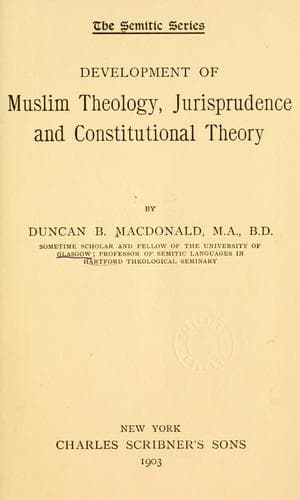
Development of Muslim Theology, Jurisprudence, and Constitutional TheoryMacDonald, Duncan Black
ReligionIslamic
Development of Muslim Theology, Jurisprudence, and Constitutional Theory
MacDonald, Duncan Black
Constitutional law (Islamic law); Islam -- Doctrines -- History; Islam and state -- History; Islamic law -- History
We have now returned to the period of al-Iji and at-Taftazani, when
philosophy definitely descended from the throne and became the servant
and defender of theology. From this time on, the two independent forces
at work are the unveiling of the mystic (_kashf_) and tradition (_naql_).
The only place for reason (_aql_) now is to prove the possibility of a
given doctrine. That done, its actual truth is proven by tradition. These
two then, _kashf_ and _naql_, hold the field, and the history of Muslim
theology from this point to the present day is the history of their
conflicts. The mystics are accused of heresy by the traditionalists.
The traditionalists are accused by the mystics of formalism, hypocrisy,
and, above all, of flat inability to argue logically. Both accusations
are certainly true. No fine fence on personality can conceal the fact
that Muslim mysticism is simple pantheism of the Plotinian type, the
individuals are emanations from the One. On the other hand, the formalism
of the traditionalists can hardly be exaggerated. They pass over almost
entirely into canon lawyers, meriting richly the fine sarcasm of
al-Ghazzali, who asked the _faqihs_ of his day what possible value for
the next world could lie in a study of the Qur’anic law of inheritance
or the like. Tradition (_hadith_), in the exact sense of the sayings and
doings of Muhammad, falls into the background, and _fiqh_, the systems
built upon it by the generations of lawyers, from the four masters down,
takes its place. Again, the accusation of illogical reasoning is also
thoroughly sound. The habit of unending subdivision deprived the minds
of the canonists of all breadth of scope, and their devotion to the
principle of acceptance on authority (_taqlid_) weakened their feeling
for argument. It is true, further, that the mystics, such as they were,
had heired all the philosophy left in Islam, and were thus become
the representatives of the intellectual life. They had so much of an
advantage over their more orthodox opponents. But the intellectual life
with them, as with the earlier philosophers, remained of a too subjective
character. The fatal study of the self, and the self only—that tramping
along the high _a priori_ road—and neglect of the objective study of
the outside world which ruined their forerunners, was their ruin as
well. Outbursts of intellectual energy and revolt we may meet with again
and again; there will be few signs of that science which seeks facts
patiently in the laboratory, the observatory, and the dissecting-room.
[Sidenote: ABD AR-RAZZAQ]
Public-domain text, read in full here on John Shaqi.
Reviews
Reviews
No reviews yet
Be the first to share your thoughts on this work.
Elsewhere in the archive
Join the Discussion
Join the discussion
Sign in to leave a comment or review.
Sign InorCreate an account