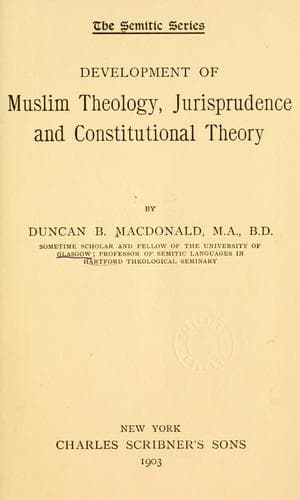
Development of Muslim Theology, Jurisprudence, and Constitutional TheoryMacDonald, Duncan Black
ReligionIslamic
Development of Muslim Theology, Jurisprudence, and Constitutional Theory
MacDonald, Duncan Black
Constitutional law (Islamic law); Islam -- Doctrines -- History; Islam and state -- History; Islamic law -- History
Curiously enough, there fall closely together at this time the death
dates of two men of the most opposite schools. The one was Ibn Taymiya,
the anthropomorphist free lance, who died in 728, and the other was
Abd ar-Razzaq, the pantheistic Sufi, who died in 730. Abd ar-Razzaq of
Samarqand and Kashan was a close student and follower of Ibn Arabi. He
commented on his books and defended his orthodoxy. In fact, so closely
had Ibn Arabi come to be identified with the Sufi position as a whole
that a defence of him was a favorite form in which to cast a defence
of Sufiism generally. But Abd ar-Razzaq did not follow his master
absolutely. On the freedom of the will especially he left him. For Ibn
Arabi, the doctrine of the oneness of all things had involved fatalism.
Whatever happens is determined by the nature of things, that is, by the
nature of God. So the individuals are bound by the whole. Abd ar-Razzaq
turned this round. His pantheism was of the same type as that of Ibn
Arabi; God, for him, was all. But there is freedom of the divine nature,
he went on. It must therefore exist in man also, for he is an emanation
from the divine. His every act, it is true, is predetermined, in time,
in form, and in place. But his act is brought about by certain causes,
themselves predetermined. These are what we would call natural laws in
things, natural abilities, aptitudes, etc., in the agent; finally, free
choice itself. And that free choice is in man because he is of and from
God. Further, it is evident that Abd ar-Razzaq’s anxiety is to preserve a
basis for morals. Among the predetermining causes he reckons the divine
commands, warnings, proofs in the Qur’an. The guidance of religion finds
thus its place and the prophets their work. But what of the existence
of evil and the necessity of restraint in a world that has emanated from
the divine? This problem he faces bravely. Our world must be the best of
all possible worlds; otherwise God would have made it better. Difference,
then, among men and things belongs to its essence and necessity. Next,
justice must consist in accepting these different things and adapting
them to their situations. To try to make all things and men alike would
be to leave some out of existence altogether. That would be a great
injustice. Here, again, religion enters. Its object is to rectify this
difference in qualities and gifts. Men are not responsible for these,
but they are responsible if they do not labor to correct them. In the
hereafter all will be reabsorbed into the divine being and taste such
bliss as the rank of each deserves. For those who need it there will be a
period of purgatorial chastisement, but that will not be eternal, _in sha
Allah_.
Public-domain text, read in full here on John Shaqi.
Reviews
Reviews
No reviews yet
Be the first to share your thoughts on this work.
Elsewhere in the archive
Join the Discussion
Join the discussion
Sign in to leave a comment or review.
Sign InorCreate an account