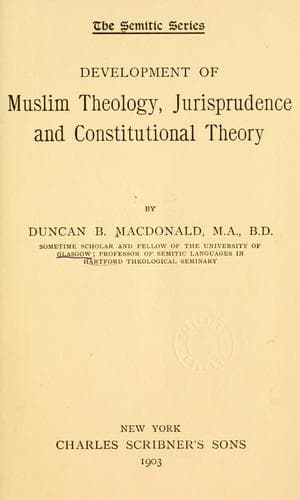
Development of Muslim Theology, Jurisprudence, and Constitutional TheoryMacDonald, Duncan Black
ReligionIslamic
Development of Muslim Theology, Jurisprudence, and Constitutional Theory
MacDonald, Duncan Black
Constitutional law (Islamic law); Islam -- Doctrines -- History; Islam and state -- History; Islamic law -- History
modern times. He did not destroy philosophy: it was dead of itself before
he came. Nor Sufiism: it is still very much alive. Nor _kalam_: it still
continues in the form to which it had crystallized by his time. But he
and his disciples made possible the Wahhabites and the monotheistic
revival of our day. The faith of Muhammad himself was not to perish
entirely from the earth.
[Sidenote: ASH-SHA‘RANI]
It would now be possible to pass at once to the Wahhabite movement in
the latter part of the twelfth century of the Hijra. All the elements
for the explanation of it and of the modern situation are in our hands.
But there is one figure which stands out so clearly in an otherwise most
obscure picture and is so significant for the time, that some account
must be taken of it. It is that of ash-Sha‘rani, theologian, canonist,
and mystic. He was a Cairene and died in 973. The rule of Egypt had
passed half a century before to the Ottoman Turks, and they governed by
means of a Turkish Pasha. The condition of the people, as we find it
sketched by ash-Sha‘rani, was a most unhappy one. They were bent down,
and especially the peasantry, under a load of taxation. The Turks found
it advisable, too, to cultivate the friendship of the canon lawyers and
professional theologians in order to maintain their hold upon the people.
These canonists, in consequence, were rapidly becoming an official class
with official privileges. Further, the process, the beginnings of which
we have already seen, by which religious science was narrowed to _fiqh_,
had gone still further. Practically, the two classes of theologians left
were the canonists and the mystics. And the mystics had fallen far from
their pride of power under the Mamluks. They now were of the poor of the
land, a kind of Essenes over against the Pharisees of the schools.
Public-domain text, read in full here on John Shaqi.
Reviews
Reviews
No reviews yet
Be the first to share your thoughts on this work.
Elsewhere in the archive
Join the Discussion
Join the discussion
Sign in to leave a comment or review.
Sign InorCreate an account