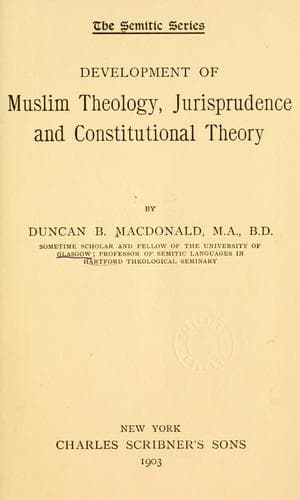
Development of Muslim Theology, Jurisprudence, and Constitutional TheoryMacDonald, Duncan Black
ReligionIslamic
Development of Muslim Theology, Jurisprudence, and Constitutional Theory
MacDonald, Duncan Black
Constitutional law (Islamic law); Islam -- Doctrines -- History; Islam and state -- History; Islamic law -- History
But it was with the Sufis that he had his worst conflicts, and at their
hands he suffered most. In many points his career is parallel to that of
Ahmad ibn Hanbal, the Sufi movement taking the place that was played by
Mu‘tazilism in the life of the earlier saint. One great difference, it
may be remarked, was that al-Ma’mun urged the persecution of Ibn Hanbal,
while an-Nasir, the great Mamluk Sultan (reg. 693, 698-708, 709-741),
supported Ibn Taymiya as far as he possibly could. The beginning of the
Sufi controversy was characteristic. Ibn Taymiya heard that a certain
an-Nasr al-Manbiji (d. 719?), a reputed follower of Ibn Arabi and of Ibn
Sab‘in, had reached a position of influence in Cairo. That was enough to
make Ibn Taymiya address an epistle to him, intended to turn him from his
heresies. It is needless to give in detail the position and content of
the epistle. He wrote as a strong monotheist of the old-fashioned type
and exposed and assailed unmercifully the doctrine of Unity (_ittihad_)
of the mystics. Al-Manbiji retorted with countercharges of heresy, and,
as he had behind him all the Sufis of Egypt—as great an army as the
Christian monks and ascetics or earlier Egypt and much like to them—Ibn
Taymiya had to pay for his eagerness for a fight with long and painful
imprisonment at Cairo, Alexandria and Damascus. Here it is evident that
he had lost touch with the drift of popular, and especially Egyptian,
feeling.
But his fearlessness was like that of Ibn Hanbal himself, and in 726
he gave out a _fatwa_ which ran still straighter in the teeth of the
beliefs of the people and which sent him to a prison which he never left
alive. It had long been a custom in Islam to make pious pilgrimage to
the graves of saints and prophets and there to do reverence to their
memory and to ask their aid. It was part of that cult of saints which
had so overspread and overcome the earlier simplicity of Islam. The most
outstanding case in point was, and is, the pilgrimage to the tomb of
Muhammad at al-Madina, which has come to be a more or less essential part
of the Hajj to the Ka‘ba itself. Against all this Ibn Taymiya lifted a
voice of emphatic protest. These shrines were in great part false, and
when they were genuine the visitation of them was an idolatrous imitation
of heathen practices. Equally idolatrous was all invoking of saints or
prophets, including Muhammad himself; to God alone should prayer be
directed. The clamor raised by this _fatwa_ was tremendous. This was
no doctrine of the schools which he had touched, but a bit of concrete
religiosity which appealed to everyone. His public life practically
ended, and the practices which he had denounced abide to this day. It is
a bitter satire on his position that when he died in 726 the populace
paid to his relics all these signs of superstitious reverence against
which he had protested. He became a saint, _malgré lui_. His work had
been to keep alive the Hanbalite doctrine and pass it on unchanged to
Public-domain text, read in full here on John Shaqi.
Reviews
Reviews
No reviews yet
Be the first to share your thoughts on this work.
Elsewhere in the archive
Join the Discussion
Join the discussion
Sign in to leave a comment or review.
Sign InorCreate an account