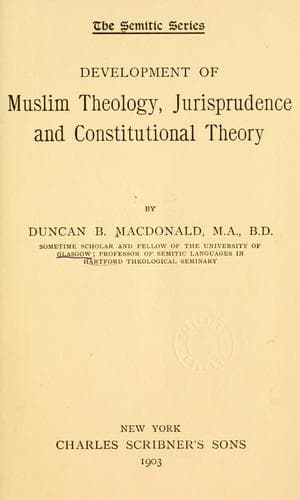
Development of Muslim Theology, Jurisprudence, and Constitutional TheoryMacDonald, Duncan Black
ReligionIslamic
Development of Muslim Theology, Jurisprudence, and Constitutional Theory
MacDonald, Duncan Black
Constitutional law (Islamic law); Islam -- Doctrines -- History; Islam and state -- History; Islamic law -- History
We must now pass over about two hundred years and come to the latter part
of the twelfth century of the Hijra, a period nearly coinciding with the
end of the eighteenth of our era. There these two movements come again to
light. Wahhabism, the historical origin of which we have already seen (p.
60), is a branch of the school of Ibn Taymiya. Manuscripts of the works
of Ibn Taymiya copied by the hand of Ibn Abd al-Wahhab exist in Europe.
So the Wahhabites refused to accept as binding the decisions of the four
orthodox sects of canon law. Agreement as a source they also reject. The
whole People of Muhammad can err and has erred. Only the agreement of
the Companions has binding force for them. It is, therefore, the duty
and right of every man to draw his own doctrine from the Qur’an and the
traditions; the systems of the schools should have no weight with him.
Again, they take the anthropomorphisms of the Qur’an in their literal
sense. God has a hand, God settles Himself on His throne; so it must be
held “without inquiring how and without comparison.” They profess to be
the only true Muslims, applying to themselves the term Muwahhids and
calling all others _Mushriks_, assigners of companions to God. Again,
like Ibn Taymiya, they reject the intercession of _walis_ with God. It
is allowable to ask of God for the sake of a saint but not to pray to
the saint. This applies also to Muhammad. Pilgrimage to the tombs of
saints, the presenting of offerings there, all acts of reverence, they
also forbid. No regard should be paid even to the tomb of the Prophet
at al-Madina. All such ceremonies are idolatrous. Whenever possible the
Wahhabites destroy and level the shrines of saints.
Over other details, such as the prohibition of the use of tobacco, we
need not spend time. Wahhabism as a political force is gone. It has,
however, left the Sanusi revolt as its direct descendant and what may be
the outcome of that Brotherhood we have no means of guessing. It has also
left a general revival and reformation throughout the Church of Islam,
much parallel, as has been remarked, to the counter-reformation which
followed the Protestant Reformation in Europe.
[Sidenote: INFLUENCE OF AL-GHAZZALI]
Public-domain text, read in full here on John Shaqi.
Reviews
Reviews
No reviews yet
Be the first to share your thoughts on this work.
Elsewhere in the archive
Join the Discussion
Join the discussion
Sign in to leave a comment or review.
Sign InorCreate an account