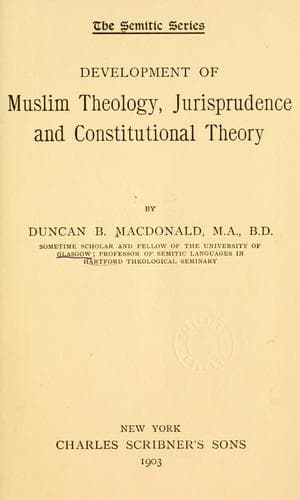
Development of Muslim Theology, Jurisprudence, and Constitutional TheoryMacDonald, Duncan Black
ReligionIslamic
Development of Muslim Theology, Jurisprudence, and Constitutional Theory
MacDonald, Duncan Black
Constitutional law (Islamic law); Islam -- Doctrines -- History; Islam and state -- History; Islamic law -- History
The second movement is the revival of the influence of al-Ghazzali. That
influence never became absolutely extinct and it seems to have remained
especially strong in al-Yaman. In that corner of the Muslim world
generations of Sufis lived comparatively undisturbed, and it was the
Sayyid Murtada, a native of Zabid in Tihama, who by his great commentary
on the _Ihya_ of al-Ghazzali practically founded the modern study of
that book. There have been two editions of this commentary in ten quarto
volumes and many of the _Ihya_ itself and of other works by al-Ghazzali.
Whether his readers understand him fully or not, there can be no question
of the wide influence which he is now exercising. At Mecca, for example,
the orthodox theological teaching is practically Ghazzalian and the
controversy throughout all Arabia is whether Ibn Taymiya and al-Ghazzali
can be called Shaykhs of Islam. The Wahhabites hold that anyone who thus
honors al-Ghazzali is an unbeliever, and the Meccans retort the same of
the followers of Ibn Taymiya.
These two tendencies then—that back to the simple monotheism of Muhammad
and that to an agnostic mysticism—are the hopeful signs in modern
Islam. There are many other drifts in which there is no such hope.
Simple materialism under European, mostly French, influence is one. A
seeking of salvation in the study of canon law is another. Canon law is
still the field to which an enormous proportion of Muslim theologians
turn. Again, there are various forms of frankly pantheistic mysticism.
That is especially the case among Persians and Turks. For the body of
the people, religion is still overburdened, as in Ibn Taymiya’s days,
with a mass of superstition. Lives of _walis_ containing the wildest
and most blasphemous stories abound and are eagerly read. The books of
ash-Sha‘rani are especially rich in such hagiology. It is difficult for
us to realize that stories like the most extravagant in the _Thousand and
One Nights_ are the simplest possibilities to the masses of Islam. The
canon lawyers, still, in their discussions, take account of the existence
of Jinn, and no theologian would dare to doubt that Solomon sealed them
up in brass bottles. Of philosophy, in the free and large sense, there
is no trace. Ibn Rushd’s reply to al-Ghazzali’s “Destruction of the
Philosophers” has been printed, but only as a pendant to that work. In
it, too, Ibn Rushd carefully covers his great heresies. His tractates on
the study of kalam, spoken of above, have also been reprinted at Cairo
from the European edition. But these tractates are arranged to give no
clew to his real philosophy. The Arabic Aristotelianism has perished
utterly from the Muslim lands. Of the modern Indian Mu‘tazilism no
account need be taken here. It is derived from Europe and is ordinary
Christian Unitarianism, connecting with Muhammad instead of with Jesus.
[Sidenote: THE PROBLEM OF THE FUTURE]
Public-domain text, read in full here on John Shaqi.
Reviews
Reviews
No reviews yet
Be the first to share your thoughts on this work.
Elsewhere in the archive
Join the Discussion
Join the discussion
Sign in to leave a comment or review.
Sign InorCreate an account