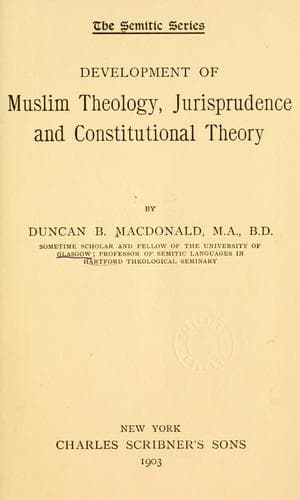
Development of Muslim Theology, Jurisprudence, and Constitutional TheoryMacDonald, Duncan Black
ReligionIslamic
Development of Muslim Theology, Jurisprudence, and Constitutional Theory
MacDonald, Duncan Black
Constitutional law (Islamic law); Islam -- Doctrines -- History; Islam and state -- History; Islamic law -- History
Then I applied myself to what of arrangement was easy of attainment and
to what of attainment was easy of arrangement, until I had crowded them
[the different opinions] into four fundamentals, which are the great
principles. The first fundamental concerns the Qualities (_sifat_)
with the Unity (_tawhid_); it embraces the question of the eternal
(_azali_) Qualities, affirmed by some and denied by others, and of
the exposition of the essential Qualities (_sifat adh-dhat_) and of
the active Qualities (_sifat al-fi‘l_) and of what is necessary in
God Most High and what is possible for Him and what is impossible; it
involves the controversies between the Ash‘arites and the Karramites and
the Anthropomorphists (_mujassims_) and the Mu‘tazilites. The second
fundamental concerns decree (_qadar_) and justice (_adl_); it embraces
the question of destiny (_qada_) and decree (_qadar_); of force (_jabr_)
and acquisition (_kasb_); of the willing of good and of evil and of
the decreed and the known, affirmed by some and denied by others; it
involves the controversies between the Qadarites and Najjarites and
Jabarites and Ash‘arites and Karramites. The third fundamental concerns
promise (_wa‘d_) and the decisions (_hukms_); it embraces the question
of faith (_iman_) and repentance (_tawba_) and threatening (_wa‘id_)
and postponing (_irja_) and pronouncing anyone an unbeliever (_takfir_)
and leading anyone astray (_tadlil_), affirmed by some and denied by
others; it involves the controversies between the Murji’ites and the
Wa‘idites and the Mu‘tazilites and the Ash‘arites and the Karramites. The
fourth fundamental concerns tradition (_sam_) and reason (_aql_) and the
prophetic mission (_risala_) and the imamate; it embraces the questions
of the determination of actions as good (_tahsin_) or vile (_taqbih_); of
the advantageous (_salah_) and most advantageous (_aslah_); of benignity
(_lutf_); of the prophets being guarded against sin (_isma_); of the
condition of the imamate, by statute (_nass_) according to some and by
agreement (_ijma_) according to others, and how it is transferred on
the view of those who say it is by statute, and how it is fixed on the
view of those who say it is by agreement; it involves the controversies
between the Shi‘ites and the Kharijites and the Mu‘tazilites and the
Karramites and the Ash‘arites.—_Translated from Cureton’s Arabic text, p.
4._
II
THE PROPHET IN A TRADITION
“Islam is built upon five things; testimony that there is no god but God
and that Muhammad is the Apostle of God. Prayer (_salat_), the Poor-rate
(_zakat_), Pilgrimage (_hajj_) and Fast (_sawm_) in Ramadan.”
A TRADITION OF THE PROPHET
Public-domain text, read in full here on John Shaqi.
Reviews
Reviews
No reviews yet
Be the first to share your thoughts on this work.
Elsewhere in the archive
Join the Discussion
Join the discussion
Sign in to leave a comment or review.
Sign InorCreate an account