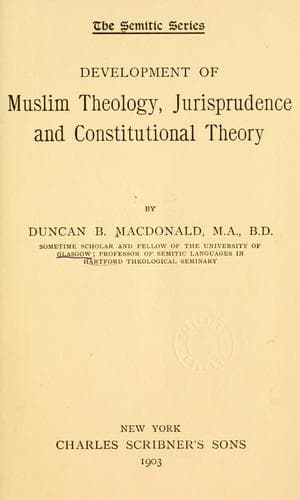
Development of Muslim Theology, Jurisprudence, and Constitutional TheoryMacDonald, Duncan Black
ReligionIslamic
Development of Muslim Theology, Jurisprudence, and Constitutional Theory
MacDonald, Duncan Black
Constitutional law (Islamic law); Islam -- Doctrines -- History; Islam and state -- History; Islamic law -- History
From the above sketch some necessary conditions are clear, which must be
fulfilled if there is to be a chance for a future development in Islam.
Education must be widely extended. The proportion of trained minds must
be greatly increased and the barrier between them and the commonalty
removed. The economy of teaching has failed; it has destroyed the
doctrine which it sought to protect. Again, the slavery of the disciple
to the master must cease. It must always be possible for the student, in
defiance of _taqlid_, to go back to first principles or to the primary
facts and to disregard what the great Imams and Mujtahids have taught.
So much of health there was in the Zahirite system.
Third, these primary facts must include the facts of natural science.
The student, emancipated from the control of the schools, must turn from
the study of himself to an examination of the great world. And that
examination must not be cosmological but biological; it must not lose
itself in the infinities but find itself in concrete realities. It must
experiment and test rather than build lofty hypotheses.
But can the oriental mind thus deny itself? The English educational
experiment in Egypt may go far to answer that question.
APPENDICES
I. ILLUSTRATIVE DOCUMENTS TRANSLATED FROM THE ARABIC.
II. SELECTED BIBLIOGRAPHY.
III. CHRONOLOGICAL TABLE.
APPENDIX I
1. ASH-SHAHRASTANI ON THE CLASSIFICATION OF MUSLIM SECTS.
2. TWO TRADITIONS FROM MUHAMMAD ON THE ESSENTIALS OF ISLAM.
3. A SHORT CREED BY AL-ASH‘ARI.
4. A SHORT CREED BY AL-GHAZZALI.
5. A SHORT CREED BY AN-NASAFI (MATARIDITE).
6. A SCHOLASTIC EXPOSITION OF THE FUNDAMENTALS OF THEOLOGY.
7. ANALYSIS OF A TREATISE IN CANON LAW.
Notes have been added where such appeared called for, but the
index, facilitating reference to the body of the book, renders
a full commentary unnecessary. The student should use the
index as a vocabulary of technical terms, referring for their
explanation to the passages where they occur.
I
ASH-SHAHRASTANI ON THE CLASSIFICATION OF MUSLIM SECTS
Public-domain text, read in full here on John Shaqi.
Reviews
Reviews
No reviews yet
Be the first to share your thoughts on this work.
Elsewhere in the archive
Join the Discussion
Join the discussion
Sign in to leave a comment or review.
Sign InorCreate an account