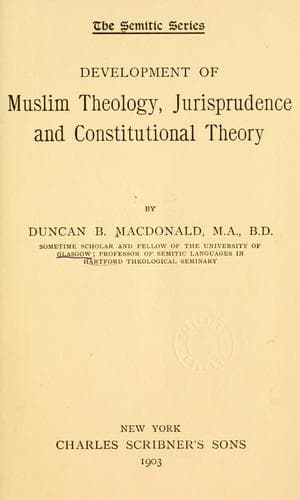
Development of Muslim Theology, Jurisprudence, and Constitutional TheoryMacDonald, Duncan Black
ReligionIslamic
Development of Muslim Theology, Jurisprudence, and Constitutional Theory
MacDonald, Duncan Black
Constitutional law (Islamic law); Islam -- Doctrines -- History; Islam and state -- History; Islamic law -- History
and not of right and of obligation, since no particular action toward
anyone is incumbent upon Him, and tyranny is inconceivable in Him, and
no one possesses a right against Him. And His right to acts of obedience
is binding upon the creatures because He has made it binding through the
tongues of His prophets, not by reason alone. But He sent apostles and
manifested their truth by plain miracles, and they brought His commands
and forbiddings and promisings and threatenings. So, belief in them as to
what they have brought is incumbent upon the creation.
THE SECOND WORD OF WITNESSING is witnessing that the apostolate belongs
to the apostle, and that God sent the unlettered Qurayshite prophet,
Muhammad, with his apostolate to the totality of Arabs and foreigners
and Jinn and men. And He abrogated by his law the other laws, except so
much of them as He confirmed; and made him excellent over the rest of the
prophets and made him the Lord of Mankind and declared incomplete the
Faith that consists in witnessing the Unity, which is saying, “There is
no god except God,” so long as there is not joined to that a witnessing
to the Apostle, which is saying, “Muhammad is the Apostle of God.” And
He made obligatory upon the creation belief in him, as to all which he
narrated concerning the things of this world and the next. And that He
would not accept the faith of a creature, so long as he did not believe
in that which the Prophet narrated concerning things after death.
The first of that is the question of Munkar and Nakir; these are two
awful and terrible beings who will cause the creature to sit up in his
grave, complete, both soul and body; and they will ask him, “Who is thy
Lord, and what is thy religion (_din_), and who is thy Prophet?” They
are the two testers in the grave and their questioning is the first
testing after death. And that he should believe in the punishment of the
grave—that it is a Verity and that its judgment upon the body and the
soul is just, according to what God wills. And that he should believe
in the Balance—it with the two scales and the tongue, the magnitude
of which is like unto the stages of the heavens and the earth. In it,
deeds are weighed by the power of God Most High; and its weights in
that day will be of the weight of motes and mustard seeds, to show the
exactitude of its justice. The leaves of the good deeds will be placed
in a beautiful form in the scale of light; and then the Balance will
be weighed down by them according to the measure of their degree with
God, by the grace of God. And the leaves of evil deeds will be cast in
a vile form into the scale of darkness, and the Balance will be light
with them, through the justice of God. And that he should believe that
the Bridge (_as-sirat_) is a Verity; it is a bridge stretched over the
back of Hell (_jahannam_), sharper than a sword and finer than a hair.
The feet of the unbelievers slip upon it, by the decree of God, and fall
with them into the Fire.
Public-domain text, read in full here on John Shaqi.
Reviews
Reviews
No reviews yet
Be the first to share your thoughts on this work.
Elsewhere in the archive
Join the Discussion
Join the discussion
Sign in to leave a comment or review.
Sign InorCreate an account