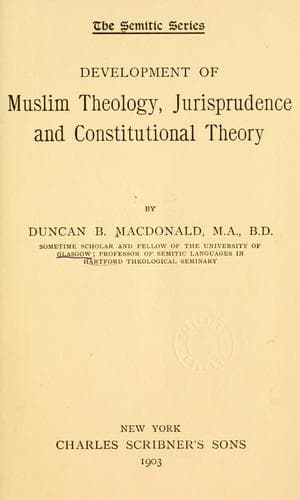
Development of Muslim Theology, Jurisprudence, and Constitutional TheoryMacDonald, Duncan Black
ReligionIslamic
Development of Muslim Theology, Jurisprudence, and Constitutional Theory
MacDonald, Duncan Black
Constitutional law (Islamic law); Islam -- Doctrines -- History; Islam and state -- History; Islamic law -- History
BY
DUNCAN B. MACDONALD, M.A., B.D.
SOMETIME SCHOLAR AND FELLOW OF THE UNIVERSITY OF
GLASGOW; PROFESSOR OF SEMITIC LANGUAGES IN
HARTFORD THEOLOGICAL SEMINARY
NEW YORK
CHARLES SCRIBNER’S SONS
1903
COPYRIGHT, 1903, BY
CHARLES SCRIBNER’S SONS
Published; March, 1903
TROW DIRECTORY
PRINTING AND BOOKBINDING COMPANY
NEW YORK
MEMORIÆ MATRIS SACRVM
PREFACE
It is with very great diffidence that I send out this book. Of the lack
and need of some text-book of the kind there can be little doubt. From
the educated man who wishes to read with intelligence his “Arabian
Nights” to the student of history or of law or of theology who wishes
to know how it has gone in such matters with the great Muslim world,
there is demand enough and to spare. Still graver is the difficulty for
the growing body of young men who are taking up the study of Arabic. In
English or German or French there is no book to which a teacher may send
his pupils for brief guidance on the development of these institutions;
on the development of law there are only scattered and fragmentary
papers, and on the development of theology there is practically nothing.
But of the difficulty of supplying this need there can be even less
doubt. Goldziher could do it fully and completely; no other Arabist alive
could approach the task other than with trepidation. The following pages
therefore form a kind of forlorn attempt, a rushing in on the part of
one who is sure he is not an angel and is in grave doubt on the question
of folly, but who also sees a gap and no great alacrity on the part of
his betters toward filling it. One thing, however, I would premise
with emphasis. All the results given here have been reached or verified
from the Arabic sources. These sources are seldom stated either in the
text or in the bibliography, as the book is intended to be useful to
non-Arabists, but, throughout, they lie behind it and are its basis.
By this it is not meant that the results of this book are claimed as
original. Every Arabist will recognize at once from whose wells I have
drawn and who have been my masters. Among these I would do homage in the
first instance to Goldziher; what Arabist is not deep in his debt? With
Goldziher’s influence through books I would join the kindred influence
of the living voice of my teacher Sachau. To him I render thanks and
reverence now for his kindly sympathy and guidance. Others in whose debt
I am are Nöldeke, Snouck Hurgronje, von Kremer, Lane—many more. Those who
are left of these will know their own in my pages and will be merciful to
my attempts to tread in their steps and to develop their results. What is
Public-domain text, read in full here on John Shaqi.
Reviews
Reviews
No reviews yet
Be the first to share your thoughts on this work.
Join the Discussion
Join the discussion
Sign in to leave a comment or review.
Sign InorCreate an account