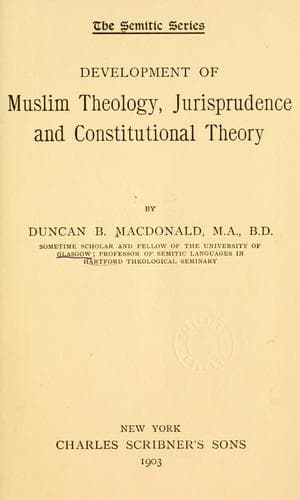
Development of Muslim Theology, Jurisprudence, and Constitutional TheoryMacDonald, Duncan Black
ReligionIslamic
Development of Muslim Theology, Jurisprudence, and Constitutional Theory
MacDonald, Duncan Black
Constitutional law (Islamic law); Islam -- Doctrines -- History; Islam and state -- History; Islamic law -- History
And the pain which is found in one who is beaten as a consequence of
being beaten by any man, and the state of being broken in glass as a
consequence of its being broken by any man, and such things, all that is
created by God Most High, and the creature has no part in its creation
and a slain man is dead because his appointed time (_ajal_) has come;
and death exists in a slain man and is created by God Most High, and the
appointed time is one.[6]
And that which is forbidden (_haram_) is still Sustenance (_rizq_), and
each one receives his own Sustenance whether it consists of permitted or
of forbidden things; and let no one imagine that a man shall not eat his
Sustenance or that another than he shall eat his Sustenance.
And God leadeth astray whom He wills and guideth aright whom He wills,
and it is not incumbent upon God Most High to do that which may be best
(_aslah_) for the creature.
The punishment of the grave for unbelievers and for some rebellious ones
of the believers, and the bliss of the obedient in the grave, and the
questioning by Munkar and Nakir are established by proofs of authority.
And the Quickening of the Dead (_ba‘th_) is a Verity, and the Weighing is
a Verity, and the Book is a Verity and the Tank (_hawd_) is a Verity, and
the Bridge, _as-Sirat_, is a Verity, and the Garden is a Verity, and the
Fire is a Verity, and they are both created, existing, continuing; they
shall not pass away and their people shall not pass away.
A great sin (_kabira_) does not exclude the creature who believes from
the Belief (_iman_) and does not make him an unbeliever. And God does
not forgive him who joins another with Himself, but He forgives anything
beneath that to whom He wills, of sins small (_saghira_) or great.
And there may be punishment for a small and pardon for a great one, if it
be not of the nature of considering lawful what is forbidden, for that is
unbelief (_kufr_). And the intercession (_shafa‘a_) of the Apostles and
of the excellent on behalf of those who commit great sins is established.
And those believers who commit great sins do not remain eternally in the
Fire although they die without repentance.
Belief (_iman_) is assent (_tasdiq_) to that which comes from God and
confession (_iqrar_) of it. Then, as for Works (_amal_), they are acts
of obedience and gradually increase of themselves, but Belief does not
increase and does not diminish. And Belief and al-Islam are one.* And
whenever assent and confession are found in a creature, it is right that
he should say, “I am a believer in truth.” And it is not fitting that he
should say, “I am a believer if God will.”*
The happy one sometimes becomes miserable and the miserable one sometimes
becomes happy,* and the changing is in happiness and misery, and not in
making happy and making miserable: for those are both qualities of God
Most High, and there is no changing in Him nor in His qualities.
Public-domain text, read in full here on John Shaqi.
Reviews
Reviews
No reviews yet
Be the first to share your thoughts on this work.
Elsewhere in the archive
Join the Discussion
Join the discussion
Sign in to leave a comment or review.
Sign InorCreate an account