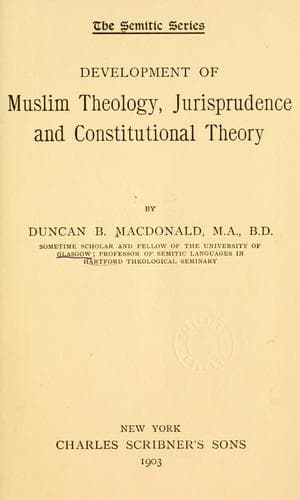
Development of Muslim Theology, Jurisprudence, and Constitutional TheoryMacDonald, Duncan Black
ReligionIslamic
Development of Muslim Theology, Jurisprudence, and Constitutional Theory
MacDonald, Duncan Black
Constitutional law (Islamic law); Islam -- Doctrines -- History; Islam and state -- History; Islamic law -- History
The fifth Quality necessary in God is self-subsistence (_qiyam
bin-nafs_). That is in the essence; and its meaning is that there
is independence of a _locus_ (_mahall_, subject) and a specifier
(_mukhassis_). The _locus_ is the essence and the specifier is the
bringer-into-existence (_mujid_); then the meaning of God’s subsisting in
Himself is that He is independent of an essence in which He may subsist,
or of a bringer-into-existence; for He is the bringer-into-existence of
all things. The proof that He subsists in Himself is that you say, “If
God had need of a _locus_, that is an essence, in which He might subsist,
as whiteness has need of an essence in which it may subsist, He would be
a quality, as whiteness, for example, is a quality. But it is not sound
to say of Him that He is a quality, for He is described by qualities, and
a quality is not described by qualities, so He is not a quality. And if
He had need of a bringer-into-existence, He would be an originated thing,
and His originator would be an originated thing also, and the Circle or
the Chain would necessarily follow. Then it stands fast that He is the
absolutely independent, that is, He is independent of everything. But the
created thing that is independent is independent in a limited sense only;
that is, of one thing in place of another. And may God rule thy guidance.”
The sixth Quality in God is Unity (_wahdaniya_). It is unity in essence
and qualities and acts in the sense of absence of multiplicity. And the
meaning of God’s being one in His essence is that His essence is not
compounded of parts, and this compounding is called internal quantity
(_kamm muttasil_). And in the sense that there is not in existence
or in possibility an essence which resembles the essence of God,
this impossibility of resemblance is called external quantity (_kamm
munfasil_). The unity, then, in the essence denies both quantities,
external and internal. And the meaning of God’s Oneness in qualities is
that He has not two qualities agreeing in name and meaning, like two
Powers, or two Knowledges or two Wills—for He has only one Power and
one Will and one Knowledge, in opposition to Abu Sahl, who held that
He had knowledges to the number of the things known. And this, I mean
multiplicity in qualities, is called internal quantity in qualities. Or
the sense is, that no one has a quality resembling a quality of God.
And this, I mean anyone possessing a quality, etc., is called external
quantity in qualities. Oneness, then, in qualities, negates quantity in
them, internal and external. And the meaning of God’s Oneness in acts is
that no created thing possesses an act, for God is the creator of the
acts of created things, prophets, angels and the rest. And as for what
happens when an individual dies or falls into pain on opposing himself
to a saint (_wali_), that is by the creation of God, who creates it when
the saint is angry with the man who opposes him. Do not then explain
Public-domain text, read in full here on John Shaqi.
Reviews
Reviews
No reviews yet
Be the first to share your thoughts on this work.
Elsewhere in the archive
Join the Discussion
Join the discussion
Sign in to leave a comment or review.
Sign InorCreate an account