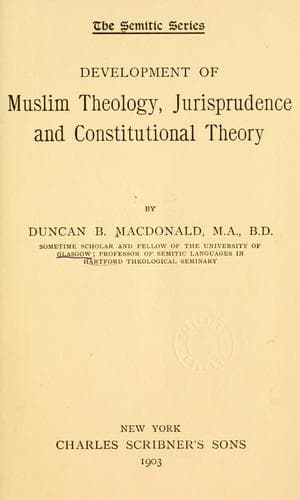
Development of Muslim Theology, Jurisprudence, and Constitutional TheoryMacDonald, Duncan Black
ReligionIslamic
Development of Muslim Theology, Jurisprudence, and Constitutional Theory
MacDonald, Duncan Black
Constitutional law (Islamic law); Islam -- Doctrines -- History; Islam and state -- History; Islamic law -- History
Oneness in acts by saying that no other than God has an act like God’s
act, for that involves that some other than God has an act, but that it
is not like the act of God. That is false. God it is who is the creator
of all acts. What comes from you by way of movement of the hand, when you
strike Zayd, for example, is by the creation of God. He has said (Qur.
37, 99), “God created you, and what do ye do?” And another than God being
possessor of an act is called external quantity in acts.
So the unity necessary in God denies the five impossible quantities.
Internal quantity in the essence makes the essence a compound of parts;
external quantity means that there is an essence which resembles it.
Internal quantity in the qualities is that God has two Powers, for
example; external quantity in them means that someone else has a quality
which resembles one of His qualities. External quantity in acts means
that some other than God possesses an act. These five quantities deny the
unity necessary in God. The meaning of quantity is number (_adad_).
The proof that Unity is necessary in God is the existence of the world.
If God had a partner (_sharik_) in divinity (_uluhiya_), the case could
not be in doubt. Either they would agree on the existence of the world,
in that one of them would say, “I will cause the world to exist,” and
the other would say, “I will cause it to exist along with thee, that we
may help one another in it.” Or they would disagree, and one of them
would say, “I will cause the world to exist by my power,” and the other,
“I will that the existence be lacking.” Then, if they agreed upon the
existence of the world in that both of them together caused it to exist,
and it existed through their action, that would necessarily involve the
coincidence of two impressors upon one impression, which is impossible.
And if they disagreed, it is plain that the will of one either would
be carried out or it would not be carried out. If the will of one,
rather than the other, is carried out, then the other whose will is not
carried out must be weaker. But our hypothesis was that he was equal in
divinity to the one whose will was carried out. So whenever weakness is
established in the case of the one, it is established in the case of the
other, for he is like the other. And if the wills of both are not carried
out, they are both weak. And upon every alternative, that they agree
or differ, the existence of a single thing of the world is impossible;
because if they agree on its existence, there necessarily follows the
coincidence of two impressors upon one impression if their will is
carried out, and that is impossible. So the carrying out of their will
is not affected, and it is not possible that a single thing of the world
should come into existence then. And if they disagree and the will of one
of them is carried out, the other is weak. But he is his like. So it is
not possible that there should come into existence a single thing of this
Public-domain text, read in full here on John Shaqi.
Reviews
Reviews
No reviews yet
Be the first to share your thoughts on this work.
Elsewhere in the archive
Join the Discussion
Join the discussion
Sign in to leave a comment or review.
Sign InorCreate an account