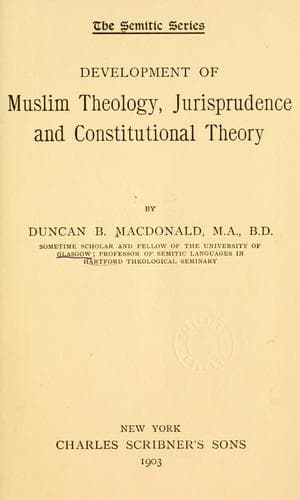
Development of Muslim Theology, Jurisprudence, and Constitutional TheoryMacDonald, Duncan Black
ReligionIslamic
Development of Muslim Theology, Jurisprudence, and Constitutional Theory
MacDonald, Duncan Black
Constitutional law (Islamic law); Islam -- Doctrines -- History; Islam and state -- History; Islamic law -- History
Let us mention to you now somewhat of that which must be held of the
things whose proofs are authority (_sam‘i_): Know that it must be
believed that our Prophet has a Tank (_hawd_); and ignorance as to
whether it is on one side or the other of the Bridge (_as-sirat_) does
not hurt. On the Day of Resurrection (_yawm al-qiyama_) the creatures
will go down to drink of it. It is different from _al-Kawthar_, which is
a River in the Garden.
And it must also be believed that he will make intercession (_shafa‘a_)
on the Day of Resurrection in the midst of the Judgment, when we shall
stand and long to depart, even though it be into the Fire. Then he shall
intercede that they may depart from the Station (_mawqif_); and this
intercession belongs to him only.
And it must also be believed that falling into great sins (_kabiras_),
other than Unbelief (_kufr_), does not involve Unbelief, but repentance
(_tawba_) from the sin is necessary at once; and if the sin be a small
one (_saghira_) repentance is necessary to him who is liable to fall into
it. And repentance is not injured by returning to sin; but for the new
sin a new repentance is necessary.
And it is incumbent upon the individual that he set aside arrogance
(_kibr_) and jealousy (_hasad_) and slander (_ghiba_) on account of what
the Prophet has said, “The gates of the Heavens have curtains which
reject the works of the people of arrogance, jealousy and slander.” That
is, they prevent them from rising, and so they are not received. Jealousy
is a desiring that the well-being of another should pass away, equally
whether it is desired that it should come to the jealous one or not.
And arrogance is considering the truth to be falsehood and rejecting it,
and despising God’s creation. And it is incumbent also upon him that he
should not spread malicious slanders among the people, for a tradition
has come down, “A slanderer (_qattat_) shall not enter the Garden.” And
jealousy is forbidden, as is said above, when the well-being does not
lead its possessor to transgression, and if it does, then desire that the
well-being should pass away is allowable.
It is necessary also to hold that some of those who commit great sins
will be punished, though it is only one of them.
Public-domain text, read in full here on John Shaqi.
Reviews
Reviews
No reviews yet
Be the first to share your thoughts on this work.
Elsewhere in the archive
Join the Discussion
Join the discussion
Sign in to leave a comment or review.
Sign InorCreate an account