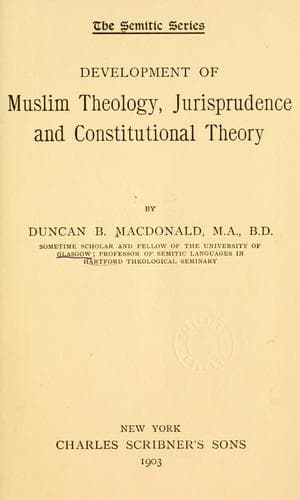
Development of Muslim Theology, Jurisprudence, and Constitutional TheoryMacDonald, Duncan Black
ReligionIslamic
Development of Muslim Theology, Jurisprudence, and Constitutional Theory
MacDonald, Duncan Black
Constitutional law (Islamic law); Islam -- Doctrines -- History; Islam and state -- History; Islamic law -- History
CONCLUSION. Faith (_iman_), in the usage of the language, is
acknowledgment that something is true (_tasdiq_), in general. In that way
it is used by God, when he reports the words of the sons of Ya‘qub (Qur.
12, 17). “But thou dost not believe us [art not a believer (_mu’min_)
in us].” Legally, it is belief in all that the Prophet has brought.
But there is a difference of opinion as to the meaning of belief, when
used in this way. Some say that it means knowledge (_ma‘rifa_) and that
everyone who knows what the Prophet has brought is a believer (_mu’min_).
But this interpretation is opposed by the fact that the unbeliever
(_kafir_) knows, but is not a believer. Nor does this interpretation
agree with the common saying, that the _muqallad_ is a believer, although
he does not know. And the right view as to the interpretation of belief
is that it is a mental utterance (_hadith an-nafs_) following conviction,
equally whether it is conviction on account of proof, which is called
knowledge, or on account of acceptance on authority (_taqlid_). This
excludes the unbeliever because he does not possess the mental utterance,
the idea of which is that you say, “I am well pleased with what the
Prophet has brought.” The mind of the unbeliever does not say this.
And it includes the _muqallad_; for he possesses the mental utterance
following conviction, though the conviction is not based on a proof.
And of that which must be believed is the genealogy of the Prophet, both
on his father’s side and on his mother’s. On his father’s side he is our
Lord, Muhammad, son of Abd Allah, son of Abd al-Muttalib, son of Hashim,
son of Abd Manaf, son of Qusay, son of Kilab, son of Murra, son of Ka‘b,
son of Lu’ay, or Luway, son of Ghalib, son of Fihr, son of Malik, son of
Nadr, son of Kinana, son of Khuzayma, son of Mudrika, son of Alyas, son
of Mudar, son of Nizar, son of Ma‘add, son of Adnan. And the Agreement
(_ijma_) unites upon this genealogy up to Adnan. But after him to Adam
there is no sure path in that which has been handed down. And as to his
genealogy on his mother’s side, she is Amina, daughter of Wahb, son of
Abd Manaf, son of Zuhra—this Abd Manaf is not the same as his ancestor on
the other line—son of Kilab, who is already one of his ancestors. So the
two lines of descent join in Kilab.
And it is necessary also to know that he was of mixed white and red
complexion, according to what some of them have said.
This is the last of that which God has made easy by His grace. His
Blessing be upon our Lord Muhammad and upon his family and his Companions
and his descendants, so so long as the mindful are mindful of him and the
heedless are heedless of the thought of him. And Praise belongeth unto
God, the Lord of the Worlds.
VII
ANALYSIS OF THE _Taqrib_ OF ABU SHUJA AL-ISPAHANI[7]
_Book I. Of Ceremonial Purity (Tahara)_
1. The water which may be used for ceremonial ablutions.
2. Legal materials for utensils; what can be purified and what cannot.
Public-domain text, read in full here on John Shaqi.
Reviews
Reviews
No reviews yet
Be the first to share your thoughts on this work.
Elsewhere in the archive
Join the Discussion
Join the discussion
Sign in to leave a comment or review.
Sign InorCreate an account