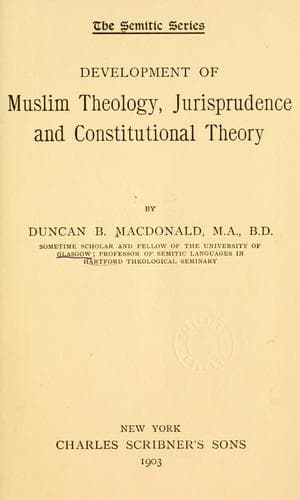
Development of Muslim Theology, Jurisprudence, and Constitutional TheoryMacDonald, Duncan Black
ReligionIslamic
Development of Muslim Theology, Jurisprudence, and Constitutional Theory
MacDonald, Duncan Black
Constitutional law (Islamic law); Islam -- Doctrines -- History; Islam and state -- History; Islamic law -- History
TO IBN SAB‘IN AND END OF MUWAHHIDS 243
CHAPTER VI
TO PRESENT SITUATION 266
APPENDICES
I. ILLUSTRATIVE DOCUMENTS IN TRANSLATION 291
II. SELECTED BIBLIOGRAPHY 358
III. CHRONOLOGICAL TABLE 368
INDEX 373
ERRATA
Page 30, line 5, for al-Mukanna read al-Muqanna.
” 86, l. 19, for first Khalifa read second Khalifa.
” 201, l. 26, for _tasalsal_ read _tasalsul_.
” 237, for Mansell read Mansel.
” 267, l. 30, for Haqqari read Hakkari.
” 299, l. 10, for _Mushriqs_ read _Mushriks_.
” 300, l. 4, for kalimatan ash-shahada read kalimata-sh-shabada.
” 325, l. 23, for _wihdaniya_ read _wahdaniya_.
” 339, l. 11, for _ihtiyaz_ read _ihtiyaj_.
Transcriber’s Note: The errata have been corrected.
DEVELOPMENT OF MUSLIM THEOLOGY, JURISPRUDENCE, AND CONSTITUTIONAL THEORY
INTRODUCTION
In human progress unity and complexity are the two correlatives forming
together the great paradox. Life is manifold, but it is also one. So
it is seldom possible, and still more seldom advisable, to divide a
civilization into departments and to attempt to trace their separate
developments; life nowhere can be cut in two with a hatchet. And this is
emphatically true of the civilization of Islam. Its intellectual unity,
for good and for evil, is its outstanding quality. It may have solved
the problem of faith and science, as some hold; it may have crushed all
thought which is not of faith, as many others hold. However that may be,
its life and thought are a unity.
Public-domain text, read in full here on John Shaqi.
Reviews
Reviews
No reviews yet
Be the first to share your thoughts on this work.
Join the Discussion
Join the discussion
Sign in to leave a comment or review.
Sign InorCreate an account