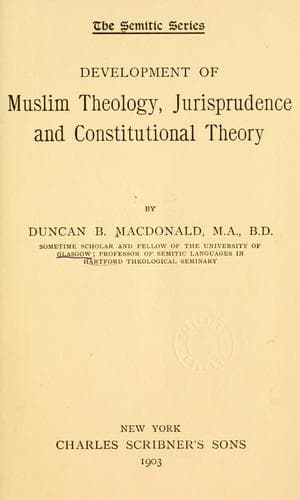
Development of Muslim Theology, Jurisprudence, and Constitutional TheoryMacDonald, Duncan Black
ReligionIslamic
Development of Muslim Theology, Jurisprudence, and Constitutional Theory
MacDonald, Duncan Black
Constitutional law (Islamic law); Islam -- Doctrines -- History; Islam and state -- History; Islamic law -- History
It will, therefore, be well for the student to work through the sketch
of a code of Muslim law which is inserted in Appendix I. One has been
chosen which belongs to the school of ash-Shafi‘i because of its general
accessibility. It should be remembered that what is given is the merest
table of contents. The standard Arabic commentary on the book extends
to eight hundred and eleven closely printed quarto pages. Even a mere
reading of this table of contents, however, will show in how different
a sphere of thought from ours Muslim law moves and lives. But we must
return to the beginning of things, to the egg from which this tremendous
system was hatched.
The mother-city of Islam was the little town of Yathrib, called Madinat
an-Nabi, the City of the Prophet, or, shortly, al-Madina, ever since the
Hijra or Migration of Muhammad to it in the year 622 of the Christian
era. Here the first Muslim state was founded, and the germinal principles
of Muslim jurisprudence fixed. Both state and jurisprudence were the
result of the inter-working of the same highly complicated causes. The
ferments in the case may be classified and described as follows: First,
in the town itself before the appearance of Muhammad on its little
stage—little, but so momentous for the future—there were two parties,
often at war, oftener at peace. There was a genuine Arab element and
there was a large settlement of Jews. To the Arabs any conception of
law was utterly foreign. An Arab tribe has no constitution; its system
is one of individualism; the single man is a sovereign and no writ can
lie against him; the tribe can cast him forth from its midst; it cannot
otherwise coerce him. So stands the case now in the desert, and so it
was then. Some slight hold there might be on the tribe through the
fear of the tribal God, but on the individual Arab, always a somewhat
cynical sceptic, that hold was of the slightest. Further, the avenging
of a broken oath was left to the God that had witnessed the oath; if he
did not care to right his client, no one else would interfere. There
was customary law, undoubtedly, but it was protected by no sanction and
enforced by no authority. If both parties chose to invoke it, well;
if not, neither had anything to fear but the anger of his opponent.
That law of custom we shall find again appearing in the system of
Islam, but there it will be backed by the sanction of the wrath of God
working through the authority of the state. The Jewish element was in
a different case. They may have been Jewish immigrants, they may have
been Jewish proselytes—many Arab tribes, we know, had gone over bodily
to Judaism—but their lives were ruled and guided by Jewish law. To the
primitive and divine legislation on Sinai there was an immense accretion
by legal fiction and by usage; the Roman codes had left their mark and
the customary law of the desert as well. All this was working in the
life of the town when Muhammad and his little band of fugitives from
Mecca entered it.
Public-domain text, read in full here on John Shaqi.
Reviews
Reviews
No reviews yet
Be the first to share your thoughts on this work.
Elsewhere in the archive
Join the Discussion
Join the discussion
Sign in to leave a comment or review.
Sign InorCreate an account