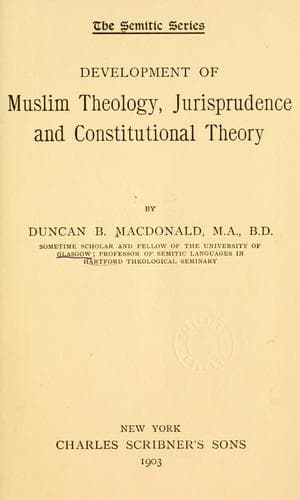
Development of Muslim Theology, Jurisprudence, and Constitutional TheoryMacDonald, Duncan Black
ReligionIslamic
Development of Muslim Theology, Jurisprudence, and Constitutional Theory
MacDonald, Duncan Black
Constitutional law (Islamic law); Islam -- Doctrines -- History; Islam and state -- History; Islamic law -- History
Being Meccans, they must have brought with them the
more developed legal ideas of that trading centre; but these were of
comparatively little account in the scale. The new and dominating element
was the personality of Muhammad himself. His contribution was legislation
pure and simple, the only legislation that has ever been in Islam.
Till his death, ten years later, he ruled his community as an absolute
monarch, as a prophet in his own right. He sat in the gate and judged
the people. He had no need of a code, for his own will was enough. He
followed the customary law of the town, as it has been described above,
when it suited him, and when he judged that it was best. If not, he left
it and there was a revelation. So the legislative part of the Qur’an
grew out of such scraps sent down out of heaven to meet the needs of the
squabbles and questions of the townsfolk of al-Madina. The system was
one of pure opportunism; but of what body of legislation can that not
be said? Of course, on the one hand, not all decisions were backed by a
revelation, and Muhammad seems, on the other, to have made a few attempts
to deal systematically with certain standing and constantly recurring
problems—such, for example, as the conflicting claims of heirs in an
estate, and the whole complicated question of divorce—but in general,
the position holds that Muhammad as a lawyer lived from hand to mouth.
He did not draw up any twelve tables or ten commandments, or code, or
digest; he was there and the people could come and ask him questions when
they chose, and that was enough. The conception of a rounded and complete
system which will meet any case and to which all cases must be adjusted
by legal fiction or equity, the conception which we owe to the genius and
experience of the Roman lawyers, was foreign to his thought. From time
to time he got into difficulties. A revelation proved too wide or too
narrow, or left out some important possibility. Then there came another
to supplement or correct, or even to set the first quite aside—Muhammad
had no scruples about progressive revelation as applied to himself.
Thus, through these interpretive acts, as we may call them, many flat
contradictions have come into the Qur’an and have proved the delight of
generations of Muslim jurisconsults.
[Sidenote: MUHAMMAD AS A LEGISLATOR]
Public-domain text, read in full here on John Shaqi.
Reviews
Reviews
No reviews yet
Be the first to share your thoughts on this work.
Elsewhere in the archive
Join the Discussion
Join the discussion
Sign in to leave a comment or review.
Sign InorCreate an account