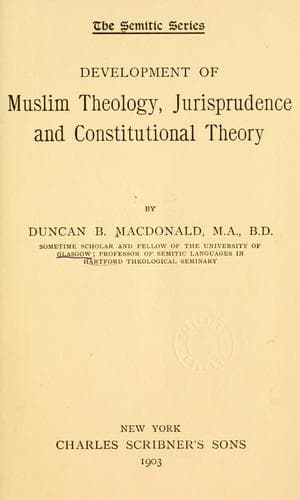
Development of Muslim Theology, Jurisprudence, and Constitutional TheoryMacDonald, Duncan Black
ReligionIslamic
Development of Muslim Theology, Jurisprudence, and Constitutional Theory
MacDonald, Duncan Black
Constitutional law (Islamic law); Islam -- Doctrines -- History; Islam and state -- History; Islamic law -- History
Such, then, was the state of things legal in al-Madina during the ten
years of Muhammad’s rule there until his death in A.D. 632. Of law there
was, strictly speaking, none. In his decisions, Muhammad could follow
certainly the customary law of the town; but to do so there was no
necessity upon him other than prudence, for his authority was absolute.
Yet even with such authority and such freedom, his task was a hard one.
The Jews, the native Arabs of al-Madina, and his fellow fugitives from
Mecca lived in more or less of friction. He had to see to it that his
decisions did not bring that friction to the point of throwing the whole
community into a flame. The Jews, it is true, were soon eliminated, but
the influence of their law lasted in the customary law of the town long
after they themselves had become insignificant. Still, with all this, the
suitor before Muhammad had no certainty on what basis his claims would be
judged; whether it would be the old law of the town, or a rough equity
based on Muhammad’s own ideas, or a special revelation _ad hoc_. So far,
then, we may be said to have the three elements—common law, equity,
legislation. Legal fiction we shall meet later; Muhammad had no need of
it.
[Sidenote: QUR’AN; USAGE OF MUHAMMAD]
But with the death of Muhammad in A.D. 632 the situation was completely
changed. We can now speak of Muslim law; legislation plays no longer any
part; the process of collecting, arranging, correlating, and developing
has begun. Consider the situation as it must have presented itself to
one of the immediate successors of Muhammad, as he sat in his place and
judged the people. When a case came up for decision, there were several
sources from which a law in point might be drawn. First among them was
the Qur’an. It had been collected from the fragmentary state in which
Muhammad had left it by Abu Bakr, his second Khalifa, some two years
after his death. Again, some ten years later, it was revised and given
forth in a final public recension by Uthman, the third Khalifa. This
was the absolute word of God—thoughts and language—and stood and, in
theory, still stands first of all sources for theology and law. If it
contained a law clearly applying to the case in hand, there was no more
to be said; divine legislation had settled the matter. If not, recourse
was next had to the decisions of the Prophet. Had a similar one come
before him, and how had he ruled? If the memories of the Companions of
the Prophet, the _Sahibs_, could adduce nothing similar from one of his
decisions, then the judge had to look further for an authority. But the
decisions of Muhammad had been many, the memories of his Companions
were capacious, and possessed further, as we must recognize with regret,
a constructive power that helped the early judges of Islam out of many
close corners. But if tradition even—true or false—finally failed, then
the judge fell back on the common law of al-Madina, that customary law
already mentioned.
Public-domain text, read in full here on John Shaqi.
Reviews
Reviews
No reviews yet
Be the first to share your thoughts on this work.
Elsewhere in the archive
Join the Discussion
Join the discussion
Sign in to leave a comment or review.
Sign InorCreate an account