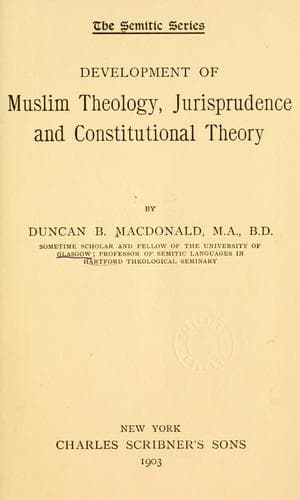
Development of Muslim Theology, Jurisprudence, and Constitutional TheoryMacDonald, Duncan Black
ReligionIslamic
Development of Muslim Theology, Jurisprudence, and Constitutional Theory
MacDonald, Duncan Black
Constitutional law (Islamic law); Islam -- Doctrines -- History; Islam and state -- History; Islamic law -- History
When that, too, failed, the last recourse was had
to the common-sense of the judge—roughly, what we would call equity.
At the beginning, therefore, of Muslim law, it had the following
sources—legislation, the usage of Muhammad, the usage of al-Madina,
equity. Naturally, as time went on and the figure of the founder drew
back and became more obscure and more venerated, equity fell gradually
into disuse; a closer search was made for decisions of that founder
which could in any way be pressed into service; a method of analogy,
closely allied to legal fiction, was built up to assist in this, and the
development of Muslim jurisprudence as a system and a science was fairly
begun. Further, in later times, the decisions of the first four Khalifas
and the agreement (_ijma_) of the immediate Companions of Muhammad came
to assume an importance only second to that of Muhammad himself. Later
still, as a result of this, the opinion grew up that a general agreement
of the jurisconsults of any particular time was to be regarded as a
legitimate source of law. But we must return to consider our subject more
broadly and in another field.
[Sidenote: LEGAL CLASSES OF ACTIONS]
The fact has already been brought out that the sphere of law is
much wider in Islam than it has ever been with us. By it all the
minutest acts of a Muslim are guarded. Europe, also, passed through a
stage similar to this in its sumptuary laws; and the tendency toward
inquisitorial legislation still exists in America, but not even the
most mediævally minded American Western State has ventured to put upon
its statute-book regulations as to the use of the toothpick and the
wash-cloth. Thus, the Muslim conception of law is so wide as to reach
essential difference. A Muslim is told by his code not only what is
required under penalty, but also what is either recommended or disliked
though without reward or penalty being involved. He may certainly consult
his lawyer, to learn how near the wind he can sail without unpleasant
consequences; but he may also consult him as his spiritual director with
regard to the relative praiseworthiness or blameworthiness of classes of
actions of which our law takes no cognizance. In consequence, actions
are divided by Muslim canon lawyers (_faqihs_) into five classes. First,
necessary (_fard_ or _wajib_); a duty the omission of which is punished,
the doing rewarded. Secondly, recommended (_mandub_ or _mustahabb_);
the doing is rewarded, but the omission is not punished. Thirdly,
permitted (_ja’iz_ or _mubah_); legally indifferent. Fourthly, disliked
(_makruh_); disapproved by the law, but not under penalty. Fifthly,
forbidden (_haram_); an action punishable by law. All this being so, it
will be easily understood that the record of the manners and customs of
the Prophet, of the little details of his life and conversation, came
to assume a high importance. Much of that was too petty ever to reach
expression in the great digests of law; not even the most zealous fixer
Public-domain text, read in full here on John Shaqi.
Reviews
Reviews
No reviews yet
Be the first to share your thoughts on this work.
Elsewhere in the archive
Join the Discussion
Join the discussion
Sign in to leave a comment or review.
Sign InorCreate an account