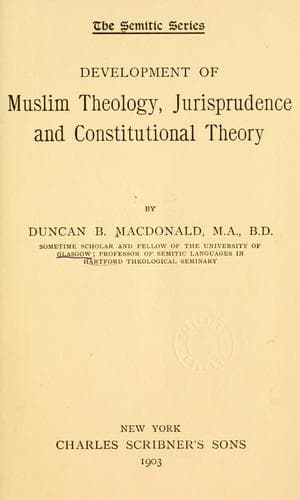
Development of Muslim Theology, Jurisprudence, and Constitutional TheoryMacDonald, Duncan Black
ReligionIslamic
Development of Muslim Theology, Jurisprudence, and Constitutional Theory
MacDonald, Duncan Black
Constitutional law (Islamic law); Islam -- Doctrines -- History; Islam and state -- History; Islamic law -- History
of life by rule and line would condemn his fellow-religionist because he
preferred to carry a different kind of walking-stick from that approved
by the Prophet, or found it fitting to arrange his hair in a different
way. But still, all pious Muslims paid attention to such things, and
fenced their lives about with the strictest Prophetic precedent.
[Sidenote: SUNNA; HADITH]
In consequence of this, there early arose in Islam a class of students
who made it their business to investigate and hand down the minutest
details as to the habits of Muhammad. This was a separate thing from the
study of law, although fated to be eventually connected with it. Even in
the time of the _Jahiliya_—the period before Islam, variously explained
as the ignorance or as the rudeness, uncivilizedness—it had been a
fixed trait of the Arab mind to hold closely to old paths. An inherent
conservatism canonized the _sunna_—custom, usage—of the ancients; any
stepping aside from it was a _bid‘a_—innovation—and had to win its way
by its merits, in the teeth of strong prejudice. With the coming of
Muhammad and the preaching of Islam, this ancestral _sunna_ had in great
part to yield. But the temper of the Arab mind remained firm, and the
sunna of Muhammad took its place. Pious Muslims did not say, “Such was
the usage of our fathers, and it is mine;” but, “I follow the usage of
the Prophet of God.” Then, just as the old sunna of the heathen times
had expressed itself through the stories of great warriors, of their
battles and loves; through anecdotes of wise men, and their keen and
eloquent words; so it was with the sunna of the one man, Muhammad. What
he said, and what he did; what he refrained from doing; what he gave
quasi-approval to by silence; all was passed on in rapidly increasing,
pregnant little narratives. First, his immediate Companions would note,
either by committing to memory or to a written record, his utterances
and table-talk generally. We have evidence of several such Boswells, who
fixed his words as they fell. Later, probably, would come notes of his
doings and his customs, and of all the little and great happenings of
the town. Above all, a record was being gathered of all the cases judged
by him, and of his decisions; of all the answers which he gave to formal
questions on religious life and faith. All this was jotted down by the
Companions on _sahifas_—odd sheets—just as they had done in the Ignorance
with the proverbs of the wise and their dark sayings. The records of
sayings were called _hadiths_; the rest, as a whole, sunna—custom, for
its details was used the plural, _sunan_—customs. At first, each man
had his own collection in memory or in writing. Then, after the death
of the Prophet and when his first Companions were dropping off, these
collections were passed on to others of the second generation. And so
the chain ran on and in time a tradition came to consist formally of
two things—the text or matter (_matn_) so handed on, and the succession
Public-domain text, read in full here on John Shaqi.
Reviews
Reviews
No reviews yet
Be the first to share your thoughts on this work.
Elsewhere in the archive
Join the Discussion
Join the discussion
Sign in to leave a comment or review.
Sign InorCreate an account