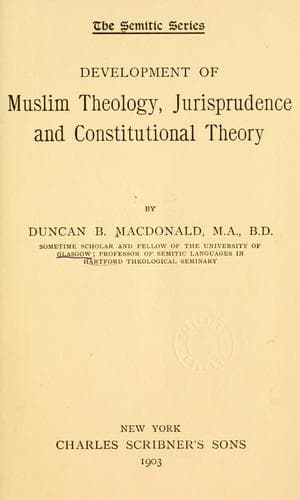
Development of Muslim Theology, Jurisprudence, and Constitutional TheoryMacDonald, Duncan Black
ReligionIslamic
Development of Muslim Theology, Jurisprudence, and Constitutional Theory
MacDonald, Duncan Black
Constitutional law (Islamic law); Islam -- Doctrines -- History; Islam and state -- History; Islamic law -- History
But another type of tradition-book was growing up, less mechanical
in arrangement. It is the _Musannaf_, the arranged, classified—and
in it the traditions are arranged in chapters according to their
subject matter. The first _Musannaf_ to make a permanent mark was the
_Sahih_—sound—of al-Bukhari, who died in A.H. 257. It is still extant
and is the most respected of all the collections of traditions. The
principle of arrangement in it is legal; that is, the traditions are
classified in these chapters so as to afford bases for a complete system
of jurisprudence. Al-Bukhari was a strong opponent of speculative law and
his book was thus a protest against a tendency which, as we shall see
later, was strong in his time. Another point in which al-Bukhari made
his influence felt and with greater effect, was increased severity in
the testing of traditions. He established very strict laws, though of a
somewhat mechanical kind, and was most scrupulous in applying them. His
book contains about seven thousand traditions, and he chose those, so
at least runs the story, out of six hundred thousand which he found in
circulation. The rest were rejected _as failing to meet his tests_. How
far the forgery of traditions had gone may be seen from the example of
Ibn Abi Awja, who was executed in A.H. 155, and who confessed that he had
himself put into circulation four thousand that were false. Another and
a similar _Sahih_ is that of Muslim, who died in A.H. 261. He was not so
markedly juristic as al-Bukhari. His object was rather to purify the mass
of existing tradition from illegitimate accretions than to construct a
basis for a complete law code. He has prefixed a valuable introduction on
the science of tradition generally. In some slight details his principle
of criticism differed from that of al-Bukhari.
These two collections, called the two _Sahihs—as-Sahihan_—are technically
_jami‘s, i.e._ they contain all the different classes of traditions,
historical, ethical, dogmatic and legal. They have also come to be, by
common agreement, the two most honored authorities in the Muslim world. A
believer finds it hard, if not impossible, to reject a tradition that is
found in both.
[Sidenote: THE SUNAN]
But there are four other collections which are called _Sunan_—Usages—and
which stand only second to the two _Sahihs_. These are by Ibn Maja
(d. 303), Abu Da’ud as-Sijistani (d. 275), at-Tirmidhi (d. 279) and
an-Nasa’i (d. 303). They deal almost entirely with legal traditions,
those that tell what is permitted and what is forbidden, and do not
convey information on religious and theological subjects. They are also
much more lenient in their criticisms of dubious traditions. To work
exclusion with them, the rejection needed to be tolerably unanimous. This
was required by their stand-point and endeavor, which was to find a basis
for all the minutest developments and details of jurisprudence, civil and
religious.
Public-domain text, read in full here on John Shaqi.
Reviews
Reviews
No reviews yet
Be the first to share your thoughts on this work.
Elsewhere in the archive
Join the Discussion
Join the discussion
Sign in to leave a comment or review.
Sign InorCreate an account