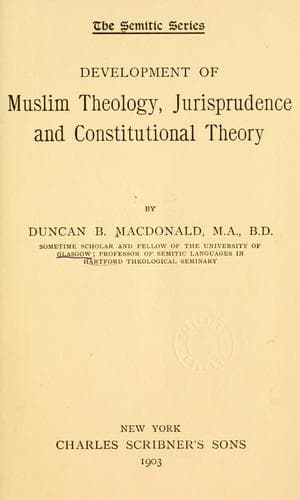
Development of Muslim Theology, Jurisprudence, and Constitutional TheoryMacDonald, Duncan Black
ReligionIslamic
Development of Muslim Theology, Jurisprudence, and Constitutional Theory
MacDonald, Duncan Black
Constitutional law (Islamic law); Islam -- Doctrines -- History; Islam and state -- History; Islamic law -- History
These six books, the two _Sahihs_ and the four _Sunans_, came to
be regarded in time as the principal and all-important sources for
traditional science. This had already come about by the end of the fifth
century, although even after that voices of uncertainty continued to make
themselves heard. Ibn Maja seems to have been the last to secure firm
footing, but even he is included by al-Baghawi (d. 516) in his _Masabih
as-sunna_, an attempted epitome into one book of what was valuable in
all. Still, long after that, Ibn Khaldun, the great historian (d. 808),
speaks of five fundamental works; and others speak of seven, adding the
_Muwatta_ of Malik to the six above. Others, again, especially in the
West, extended the number of canonical works to ten, though with varying
members; but all these must be regarded as more or less local, temporary,
and individual eccentricities. The position of the six stands tolerably
firm.
So much it has been necessary to interpolate and anticipate with regard
to the students of tradition whose interest lay in gathering up and
preserving, not in using and applying. From the earliest time, then,
there existed these two classes in the bosom of Islam, students of
tradition proper and of law proper. For long they did not clash; but a
collision was inevitable sooner or later.
Yet, if the circle of the Muslim horizon had not widened beyond the
little market-town of al-Madina, that collision might have been long in
coming. Its immediate causes were from without, and are to be found in
the wave of conquest that carried Islam, within the century, to Samarqand
beyond the Oxus and to Tours in central France. Consider what that wave
of conquest was and meant. Within fourteen years of the Hijra, Damascus
was taken, and within seventeen years, all Syria and Mesopotamia. By the
year 21, the Muslims held Persia; in 41 they were at Herat, and in 56
they reached Samarqand. In the West, Egypt was taken in the year 20; but
the way through northern Africa was long and hard. Carthage did not fall
till 74, but Spain was conquered with the fall of Toledo in 93. It was in
A.D. 732, the year of the Hijra 114, that the wave at last was turned
and the mercy of Tours was wrought by Charles the Hammer; but the Muslims
still held Narbonne and raided in Burgundy and the Dauphiné. The wealth
that flowed into Arabia from these expeditions was enormous; money and
slaves and luxuries of every kind went far to transform the old life of
hardness and simplicity. Great estates grew up: fortunes were made and
lost; the intricacies of the Syrian and Persian civilizations overcame
their conquerors. All this meant new legal conditions and problems. The
system that had sufficed to guard the right to a few sheep or camels
had to be transformed before it would suffice to adjust the rights and
claims of a tribe of millionnaires. But it must not be thought that
these expeditions were only campaigns of plunder. With the Muslim armies
Public-domain text, read in full here on John Shaqi.
Reviews
Reviews
No reviews yet
Be the first to share your thoughts on this work.
Elsewhere in the archive
Join the Discussion
Join the discussion
Sign in to leave a comment or review.
Sign InorCreate an account