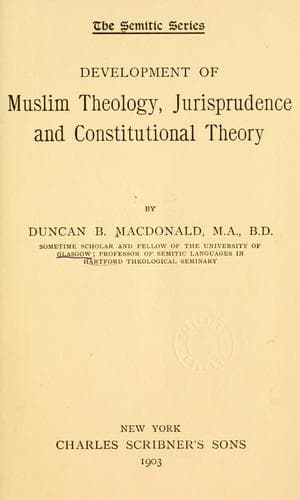
Development of Muslim Theology, Jurisprudence, and Constitutional TheoryMacDonald, Duncan Black
ReligionIslamic
Development of Muslim Theology, Jurisprudence, and Constitutional Theory
MacDonald, Duncan Black
Constitutional law (Islamic law); Islam -- Doctrines -- History; Islam and state -- History; Islamic law -- History
The Abbasids came to power in the year of the Hijra 132, and in 150
died Abu Hanifa, the first student and teacher to leave behind him a
systematic body of teaching and a missionary school of pupils. He was
a Persian by race, and perhaps the most distinguished example of the
rule that Muslim scientists and thinkers might write in Arabic but were
seldom of Arab blood. He does not seem to have held office as a judge
or to have practised law at all. He was, rather, an academic student, a
speculative or philosophical jurist we might call him. His system of law,
therefore, was not based upon the exigencies of experience; it did not
arise from an attempt to meet actual cases. We might say of it, rather,
but in a good sense, that it was a system of casuistry, an attempt to
build up on scientific principles a set of rules which would answer every
conceivable question of law. In the hands of some of his pupils, when
applied to actual facts, it tended to develop into casuistry in a bad
sense; but no charge of perverting justice for his own advantage seems to
have been brought against Abu Hanifa himself. His chief instruments in
constructing his system were opinion and analogy. He leaned little upon
traditions of the usage of Muhammad, but preferred to take the Qur’anic
texts and develop from them his details. But the doing of this compelled
him to modify simple opinion—equivalent to equity as we have seen—and
limit it to analogy of some written statute (_nass_). He could hardly
forsake a plain _res iudicata_ of Muhammad, and follow his own otherwise
unsupported views, but he might choose to do so if he could base it on
analogy from the Qur’an. Thus, he came to use what was practically legal
fiction. It is the application of an old law in some sense or way that
was never dreamt of by the first imposer of the law, and which may, in
fact, run directly counter to the purpose of the law. The fiction is
that it is the original law that is being observed, while, as a matter
of fact, there has come in its place an entirely different law. So Abu
Hanifa would contend that he was following the divine legislation of the
Qur’an, while his adversaries contended that he was only following his
own opinion.
But if, on the one hand, he was thus limited from equity to legal
fiction, on another he developed a new principle of even greater freedom.
Reference has already been made to the changes which were of necessity
involved in the new conditions of the countries conquered by the Muslims.
Often the law of the desert not only failed to apply to town and
agricultural life; it was even directly mischievous. On account of this,
a consideration of local conditions was early accepted as a principle,
but in general terms. These were reduced to definiteness by Abu Hanifa
under the formula of “holding for better” (_istihsan_). He would say,
“The analogy in the case points to such and such a rule, but under the
circumstances I hold it for better to rule thus and thus.”
Public-domain text, read in full here on John Shaqi.
Reviews
Reviews
No reviews yet
Be the first to share your thoughts on this work.
Elsewhere in the archive
Join the Discussion
Join the discussion
Sign in to leave a comment or review.
Sign InorCreate an account