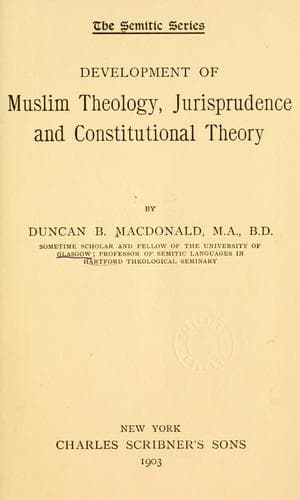
Development of Muslim Theology, Jurisprudence, and Constitutional TheoryMacDonald, Duncan Black
ReligionIslamic
Development of Muslim Theology, Jurisprudence, and Constitutional Theory
MacDonald, Duncan Black
Constitutional law (Islamic law); Islam -- Doctrines -- History; Islam and state -- History; Islamic law -- History
Exactly in the same way it befell the old Muslims. The theological
reformation was sweeping and complete. The first Abbasids were pious,
at least outwardly; the state was put upon a pious footing. The canon
law also was formally restored, but with large practical modifications.
Canon lawyers were received into the service of the state, provided they
were adaptable enough. Impossible men had no place under the Abbasids;
their officials must be pliable and dexterous, for a new _modus vivendi_
was to be found. The rough and ready Umayyad cutting of the knot had
failed; the turn had now come for piety and dexterity in twisting law.
The court lawyers learned to drive a coach and four through any of the
old statutes, and found their fortunes in their brains. So the issue was
bridged. But a large party of malcontents was left, and from this time on
in Islam the lawyers and the theologians have divided into two classes,
the one admitting, as a matter of expediency, the authority of the
powers of the time and aiding them in their task as rulers; the other,
irreconcilable and unreconciled, denouncing the state as sunk in unbelief
and deadly sin and its lawyers as traitors to the cause of religion. To
pursue our parallel, they are represented in Scotland by a handful of
Covenanting congregations and in America by the much more numerous and
powerful Reformed Presbyterian Church.
It is a significant fact that with the lifting of the Umayyad pressure
and the encouragement of legal studies—such as it was—by the Abbasids,
definite and recognized schools of law began to form. What had so long
been in process in secret became public, and its results crystallized
under certain prominent teachers. We will now take up these schools in
the order of the death dates of their founders; we will establish their
principles and trace their histories. We shall find the same conceptions
recurring again and again which have already been brought out, Qur’an,
tradition (_hadith_), agreement (_ijma_), opinion (_ra’y_), analogy
(_qiyas_), local usage (_urf_), preference (_istihsan_), in the teeth of
the written law—till at length, when the battle is over, the sources will
have limited themselves to the four which have survived to the present
day—Qur’an, tradition, agreement, analogy. And, similarly, of the six
schools to be mentioned, four only will remain to the present time, but
these of equal rank and validity in the eyes of the Believers.
[Sidenote: ABU HANIFA]
Public-domain text, read in full here on John Shaqi.
Reviews
Reviews
No reviews yet
Be the first to share your thoughts on this work.
Elsewhere in the archive
Join the Discussion
Join the discussion
Sign in to leave a comment or review.
Sign InorCreate an account