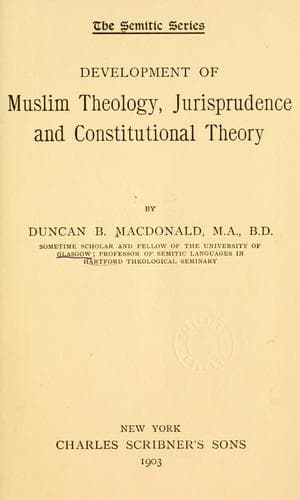
Development of Muslim Theology, Jurisprudence, and Constitutional TheoryMacDonald, Duncan Black
ReligionIslamic
Development of Muslim Theology, Jurisprudence, and Constitutional Theory
MacDonald, Duncan Black
Constitutional law (Islamic law); Islam -- Doctrines -- History; Islam and state -- History; Islamic law -- History
But all the canon lawyers did not fall in so easily with the new ways.
Many found that only in asceticism, in renunciation of the world and
engaging in pious exercises was there any chance of their maintaining
the old standards in a state that was for them based on oppression and
robbery. One of these was Sufyan ath-Thawri, a lawyer of high repute,
who narrowly missed founding a separate school of law and who died in
161. There has come down to us a correspondence between him and Harun,
which, though it cannot possibly be genuine, throws much light on the
disappointment of the sincerely religious section. Harun writes on his
accession to the Khalifate (170), complaining that Sufyan had not visited
him, in spite of their bond of brotherhood, and offering him wealth
from the public treasury. Sufyan replied, denouncing such use of public
funds and all the other uses of them by Harun—many enough—except those
precisely laid down in the codes. On the basis of these, Harun would have
had to work for his own living. There are also other denunciations for
crimes in the ruler which he punished in others. Harun is said to have
kept the letter and wept over it at intervals, but no change of life on
his part is recorded. Apparently, with the accession of the Abbasids
ascetic and mystical Islam made a great development. It became plain to
the pious that no man could inherit both this world and the next.
While Abu Hanifa was developing his system in Mesopotamia, al-Awza‘i
was working similarly in Syria. He was born at Baalbec, lived at
Damascus, and at Beyrout where he died in 157. Of him and his teaching
we know comparatively little. But so far it is clear that he was not a
speculative jurist of the same type as Abu Hanifa, but paid especial
attention to traditions. At one time his school was followed by the
Muslims of Syria and the entire West to Morocco and Spain. But its day
was a short one. The school of Abu Hanifa, championed by Abu Yusuf with
his tremendous influence as chief Qadi of the Abbasid empire, pushed it
aside, and at the present day it has no place except in history. For us,
its interest is that of another witness to the early rise and spread of
systems of jurisprudence outside of Arabia.
[Sidenote: MALIK IBN ANAS]
Public-domain text, read in full here on John Shaqi.
Reviews
Reviews
No reviews yet
Be the first to share your thoughts on this work.
Elsewhere in the archive
Join the Discussion
Join the discussion
Sign in to leave a comment or review.
Sign InorCreate an account