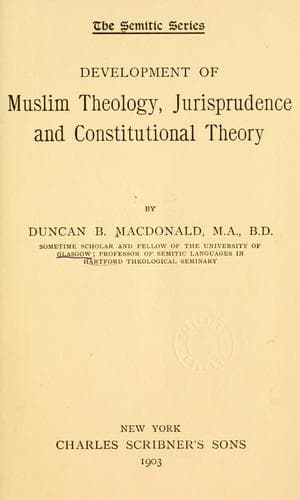
Development of Muslim Theology, Jurisprudence, and Constitutional TheoryMacDonald, Duncan Black
ReligionIslamic
Development of Muslim Theology, Jurisprudence, and Constitutional Theory
MacDonald, Duncan Black
Constitutional law (Islamic law); Islam -- Doctrines -- History; Islam and state -- History; Islamic law -- History
In A.H. 179, three years before the death of Abu Yusuf and twenty-nine
after that of Abu Hanifa, there died at al-Madina the founder and head
of an independent school of a very different type. This was Malik ibn
Anas, under whose hands what we may call, for distinction, the historical
school of al-Madina took form. Al-Madina, it will be remembered, was the
mother-city of Muslim law. It was the special home of the traditions
of the Prophet and the scene of his legislative and judicial life. Its
pre-Islamic customary law had been sanctioned, in a sense, by his use. It
had been the capital of the state in its purest days. From the height of
all these privileges its traditionists and lawyers looked down upon the
outsiders and _parvenus_ who had begun to intermeddle in sacred things.
But it must not be thought that this school was of a rigid traditionism.
The case was quite the reverse, and in many respects it is hard to make a
distinction between it and that of Abu Hanifa. Its first source was, of
necessity, the Qur’an. Then came the usage of the Prophet. This merged
into the usage of the Successors of the Prophet and the unwritten custom
of the town. It will be seen that here the historical weight of the place
came to bear. No other place, no other community, could furnish that
later tradition with anything like the same authority. Further, Malik ibn
Anas was a practical jurist, a working judge. He was occupied in meeting
real cases from day to day. When he sat in public and judged the people,
or with his pupils around him and expounded and developed the law, he
could look back upon a line of canon lawyers who had sat in his place
and done as he was doing. In that lies the great difference. He was in
practical touch with actual life; that was one point; and, secondly, he
was in the direct line of the apostolic succession, and in the precise
environment of the Prophet. So when he went beyond Qur’an, prophetic
usage, agreement, and gave out decisions on simple opinion, the feeling
of the community justified him. It was a different thing for Malik ibn
Anas, sitting there in state in al-Madina, to use his judgment, than
for some quick-brained vagabond of a Persian or Syrian proselyte, some
_pauvre diable_ with neither kith nor kin in the country, to lay down
principles of law. So the pride of the city of the Prophet distinguished
between him and Abu Hanifa.
Public-domain text, read in full here on John Shaqi.
Reviews
Reviews
No reviews yet
Be the first to share your thoughts on this work.
Elsewhere in the archive
Join the Discussion
Join the discussion
Sign in to leave a comment or review.
Sign InorCreate an account