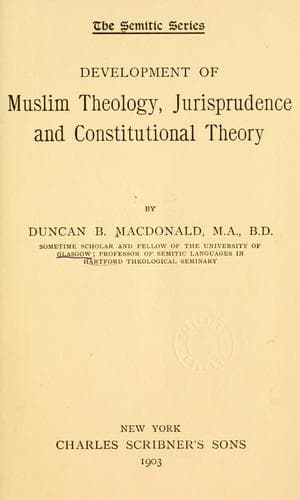
Development of Muslim Theology, Jurisprudence, and Constitutional TheoryMacDonald, Duncan Black
ReligionIslamic
Development of Muslim Theology, Jurisprudence, and Constitutional Theory
MacDonald, Duncan Black
Constitutional law (Islamic law); Islam -- Doctrines -- History; Islam and state -- History; Islamic law -- History
It is evident that here we have to do with an impossible man and school,
and so the Muslim world found. Most said roundly that it was illegal
to permit a Zahirite to act as judge, on much the same grounds that
objection to circumstantial evidence will throw out a man now as juror.
If they had been using modern language, they would have said that it
was because he was a hopeless crank. Yet the Zahirite school lasted for
centuries and drew long consequences, historical and theological, for
which there is no space here. It never held rank as an acknowledged
school of Muslim law.
We now come to the last of the four schools, and it, strange as its
origin was, need not detain us long. The Zahirite reaction had failed
through its very extremeness. It was left to a dead man and a devoted
Shafi‘ite to head the last attack upon the school of his master. Ahmad
ibn Hanbal was a theologian of the first rank; he made no claim to be a
constructive lawyer. His _Musnad_ has already been dealt with. It is an
immense collection of some thirty thousand traditions, but these are not
even arranged for legal purposes. He suffered terribly for the orthodox
faith in the rationalist persecution under the Khalifa al-Ma’mun, and his
sufferings gained him the position of a saint. But he never dreamed of
forming a school, least of all in opposition to his master, ash-Shafi‘i.
He died in 241, and after his death his disciples drew together and
the fourth school was founded. It was simply reactionary and did not
make progress in any way. It minimized agreement and analogy and tended
toward literal interpretation. As might be expected from its origin, its
history has been one of violence, of persecution and counter-persecution,
of insurrection and riot. Again and again the streets of Baghdad ran
blood from its excesses. It has now the smallest following of the four
surviving schools.
[Sidenote: PRINCIPLES OF UNITY AND VARIETY]
Public-domain text, read in full here on John Shaqi.
Reviews
Reviews
No reviews yet
Be the first to share your thoughts on this work.
Elsewhere in the archive
Join the Discussion
Join the discussion
Sign in to leave a comment or review.
Sign InorCreate an account