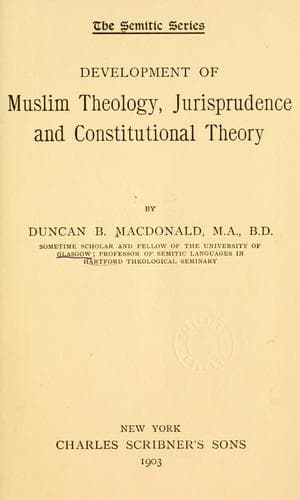
Development of Muslim Theology, Jurisprudence, and Constitutional TheoryMacDonald, Duncan Black
ReligionIslamic
Development of Muslim Theology, Jurisprudence, and Constitutional Theory
MacDonald, Duncan Black
Constitutional law (Islamic law); Islam -- Doctrines -- History; Islam and state -- History; Islamic law -- History
But the extreme traditionists were little satisfied with this compromise.
They objected to analogy and they objected to agreement; nothing but the
pure law of God and the Prophet would satisfy them. And their numbers
were undoubtedly large. The common people always heard traditions gladly,
and it was easy to turn to ridicule the subtleties of the professional
lawyers. How much simpler, it struck the average mind, it would be
to follow some clear and unambiguous saying of the Prophet; then one
could feel secure. This desire of the plain man to take traditions and
interpret them strictly and literally was met by the school of Da’ud
az-Zahiri, David the literalist. He was born three or four years before
the death of ash-Shafi‘i, which occurred in 204. He was trained as a
Shafi‘ite and that, too, of the narrower, more traditional type; but
it was not traditional enough for him. So he had to cut himself loose
and form a school of his own. He rejected utterly analogy; he limited
agreement, as a source, to the agreement of the immediate Companions of
Muhammad, and in this he has been followed by the Wahhabites alone among
moderns; he limited himself to Qur’an and prophetic usage.
In another point also, he diverged. Ash-Shafi‘i had evidently exercised
a very great personal influence upon his followers. All looked up to him
and were prepared to swear to his words. So there grew up a tendency
for a scholar to take a thing upon the word of his master. “Ash-Shafi‘i
taught so; I am a Shafi‘ite and I hold so.” This, too, Da’ud utterly
rejected. The scholar must examine the proofs for himself and form his
own opinion. But he had another peculiarity, and one which gained him
the name of literalist. Everything, Qur’an and tradition, must be taken
in the most exact sense, however absurd it might be. Of course, to have
gone an inch beyond the very first meaning of the words would have been
to stray in the direction of analogy. Yet, as fate would have it, to
analogy, more or less, he had in the end to come. The inexorable law that
the limited cannot bound the unlimited was proved again. “Analogy is
like carrion,” confessed a very much earlier traditionist, “when there
is nothing else you eat it.” Da’ud tried to make his meal more palatable
by a change in name. He called it a proof (_dalil_) instead of a source
(_asl_); but what difference of idea he involved in that it is hard to
determine. This brought him to the doctrine of cause, already mentioned.
Were we at liberty to seek the cause of a divine word or action and lead
our “proof” from that? If the cause was directly stated, then Da’ud held
that we must regard it as having been the cause in this case; but we were
not at liberty, he added, to look for it, or on it, as cause in any other
case.
Public-domain text, read in full here on John Shaqi.
Reviews
Reviews
No reviews yet
Be the first to share your thoughts on this work.
Elsewhere in the archive
Join the Discussion
Join the discussion
Sign in to leave a comment or review.
Sign InorCreate an account