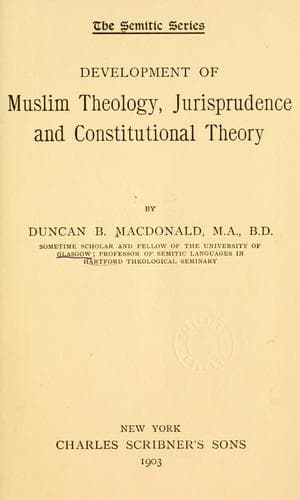
Development of Muslim Theology, Jurisprudence, and Constitutional TheoryMacDonald, Duncan Black
ReligionIslamic
Development of Muslim Theology, Jurisprudence, and Constitutional Theory
MacDonald, Duncan Black
Constitutional law (Islamic law); Islam -- Doctrines -- History; Islam and state -- History; Islamic law -- History
But there is a third principle at work which we cannot view with the
same favor. As said above, every Muslim must attach himself to a legal
school, and may choose any one of these four. But once he has chosen his
school he is absolutely bound by the decisions and rules of that school.
This is the principle against which the Zahirites protested, but their
protest, the only bit of sense they ever showed, was in vain. The result
of its working throughout centuries has been that now no one—except
from a spirit of historical curiosity—ever dreams of going back from
the text-books of the present day to the works of the older masters.
Further, such an attempt to get behind the later commentaries would not
be permitted. We have comment upon comment upon comment, abstract of this
and expansion of that; but each hangs by his predecessor and dares not go
another step backward. The great masters of the four schools settled the
broad principles; they were authorities of the first degree (_mujtahidun
mutlaq_), second to Muhammad in virtue of his inspiration only. Second,
came the masters who had authority within the separate schools
(_mujtahidun fi-l-madhahib_) to determine the questions that arose
there. Third, masters of still lesser rank for minor points (_mujtahidun
bil-fatwa_). And so the chain runs on. The possibility of a new legal
school arising or of any considerable change among these existing schools
is flatly denied. Every legist now has his place and degree of liberty
fixed, and he must be content.
[Sidenote: THE CANON AND CIVIL CODES]
Public-domain text, read in full here on John Shaqi.
Reviews
Reviews
No reviews yet
Be the first to share your thoughts on this work.
Elsewhere in the archive
Join the Discussion
Join the discussion
Sign in to leave a comment or review.
Sign InorCreate an account