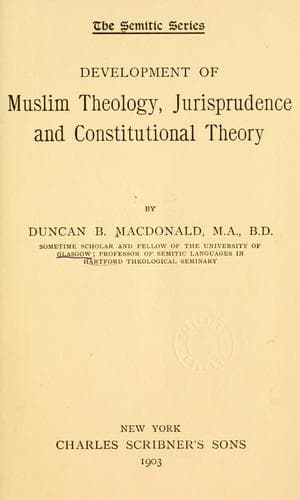
Development of Muslim Theology, Jurisprudence, and Constitutional TheoryMacDonald, Duncan Black
ReligionIslamic
Development of Muslim Theology, Jurisprudence, and Constitutional Theory
MacDonald, Duncan Black
Constitutional law (Islamic law); Islam -- Doctrines -- History; Islam and state -- History; Islamic law -- History
These three principles, then, of catholic unity and its ability to
make and abrogate laws, of the liberty of diversity in that unity, and
of blind subjection to the past within that diversity, these three
principles must be our hope and fear for the Muslim peoples. What that
future will be none can tell. The grasp of the dead hand of Islam is
close, but its grip at many points has been forced to relax. Very early,
as has already been pointed out, the canon law had to give way to the
will of the sovereign, and ground once lost it has never regained. Now,
in every Muslim country, except perhaps the Wahhabite state in central
Arabia, there are two codes of law administered by two separate courts.
The one judges by this canon law and has cognizance of what we may call
private and family affairs, marriage, divorce, inheritance. Its judges,
at whose head in Turkey stands the Shaykh al-Islam, a dignity first
created by the Ottoman Sultan Muhammad II in 1453, after the capture
of Constantinople, also give advice to those who consult them on such
personal matters as details of the ritual law, the law of oaths and
vows, etc. The other court knows no law except the custom of the country
(_urf_, _ada_) and the will of the ruler, expressed often in what are
called _Qanuns_, statutes. Thus, in Turkey at the present day, besides
the codices of canon law, there is an accepted and authoritative corpus
of such _Qanuns_. It is based on the _Code Napoléon_ and administered
by courts under the Minister of Justice. This is the nearest approach
in Islam to the development by statute, which comes last in Sir Henry
Maine’s analysis of the growth of law. The court guided by these _Qanuns_
decides all matters of public and criminal law, all affairs between man
and man. Such is the legal situation throughout the whole Muslim world,
from Sulu to the Atlantic and from Africa to China. The canon lawyers, on
their side, have never admitted this to be anything but flat usurpation.
There have not failed some even who branded as heretics and unbelievers
those who took any part in such courts of the world and the devil. They
look back to the good old days of the rightly guided Khalifas, when there
was but one law in Islam, and forward to the days of the Mahdi when that
law will be restored. There, between a dead past and a hopeless future,
we may leave them. The real future is not theirs. Law is greater than
lawyers, and it works in the end for justice and life.
[Sidenote: DISTRIBUTION OF SCHOOLS]
Public-domain text, read in full here on John Shaqi.
Reviews
Reviews
No reviews yet
Be the first to share your thoughts on this work.
Elsewhere in the archive
Join the Discussion
Join the discussion
Sign in to leave a comment or review.
Sign InorCreate an account