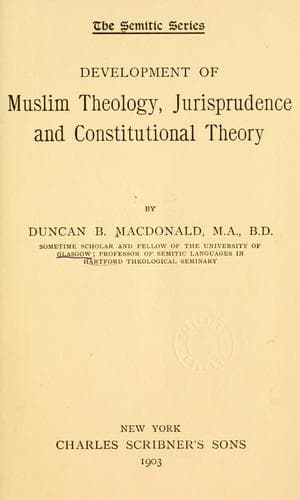
Development of Muslim Theology, Jurisprudence, and Constitutional TheoryMacDonald, Duncan Black
ReligionIslamic
Development of Muslim Theology, Jurisprudence, and Constitutional Theory
MacDonald, Duncan Black
Constitutional law (Islamic law); Islam -- Doctrines -- History; Islam and state -- History; Islamic law -- History
Yet two sects loom up through the mist and their existence can be
tolerably conditioned through the historical facts and philosophical
necessities of the time. The one is that of the Murji’ites, and the
other of the Qadarites. A Murji’ite is literally “one who defers or
postpones,” in this case postpones judgment until it is pronounced by
God on the Day of Judgment. They arose as a sect during and out of the
civil war between the Shi‘ites, the Kharijites and the Umayyads. All
these parties claimed to be Muslims, and most of them claimed that they
were the only true Muslims and that the others were unbelievers. This
was especially the attitude of the Shi‘ites and Kharijites toward the
Umayyads; to them, the Umayyads, as we have seen already, were godless
heathen who professed Islam, but oppressed and slaughtered the true
saints of God. The Murji’ites, on the other hand, worked out a view on
which they could still support the Umayyads without homologating all
their actions and condemning all their opponents. The Umayyads, they
held, were _de facto_ the rulers of the Muslim state; fealty had been
sworn to them and they confessed the Unity of God and the apostleship
of the Prophet. Thus, they were not polytheists, and there is no sin
that can possibly be compared with the sin of polytheism (_shirk_). It
was, therefore, the duty of all Muslims to acknowledge their sovereignty
and to postpone until the secrets of the Last Day all judgment or
condemnation of any sins they might have committed. Sins less than
polytheism could justify no one in rising in revolt against them and in
breaking the oath of fealty.
Such seems to have been the origin of the Murji’ites, and it was the
origin also of the theory of the accomplished fact in the state, of which
we have had to take account several times. Thus, between the fanatical
venerators of the canon law, to whom all the Khalifas, after the first
four, were an abomination, and the purely worldly lawyers of the court
party, there came a group of pious theologians who taught that the good
of the Muslim community required obedience to the ruler of the time, even
though his personal unworthiness were plain. As a consequence, success
can legitimate anything in the Muslim state.
Public-domain text, read in full here on John Shaqi.
Reviews
Reviews
No reviews yet
Be the first to share your thoughts on this work.
Elsewhere in the archive
Join the Discussion
Join the discussion
Sign in to leave a comment or review.
Sign InorCreate an account