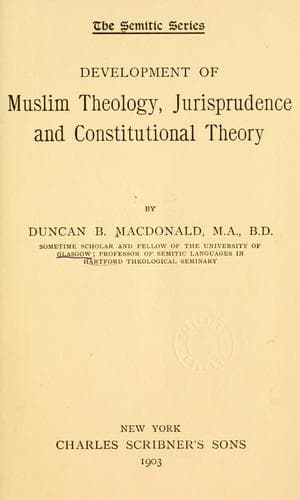
Development of Muslim Theology, Jurisprudence, and Constitutional TheoryMacDonald, Duncan Black
ReligionIslamic
Development of Muslim Theology, Jurisprudence, and Constitutional Theory
MacDonald, Duncan Black
Constitutional law (Islamic law); Islam -- Doctrines -- History; Islam and state -- History; Islamic law -- History
speculation in theology as in law, and his followers have walked in his
path. Even the mystical light has been touched in our view of the theory
of the state. It has flourished most among the Shi‘ites, who are driven
to seek and to find an inner meaning under the plain word of the Qur’an,
and whose devotion to Ali and his house and to their divine mission has
kept alive the thought of a continuous speaking of God to mankind and of
an exalting of mankind into the presence of God. It is for the student,
then, to watch and hold fast these three guiding threads.
* * * * *
The development of Muslim theology, like that of jurisprudence, could not
begin till after the death of Muhammad. So long as he lived and received
infallible revelations in solution of all questions of faith or usage
that might come up, it is obvious that no system of theology could be
formed or even thought of. Traditions, too, which have reached us, even
show him setting his face against all discussions of dogma and repeating
again and again, in answer to metaphysical and theological questions, the
crude anthropomorphisms of the Qur’an. But these questions and answers
are probably forgeries of the later traditional school, shadows of future
warfare thrown back upon the screen of the patriarchal age. Again, in
the first twenty or thirty years after Muhammad’s death, the Muslims
were too much occupied with the propagation of their faith to think
what that faith exactly was. Thus, it seems that the questioning spirit
in this direction was aroused comparatively late and remained for some
time on what might be called a private basis. Individual men had their
individual views, but sects did not quickly arise, and when they did were
vague and hard to define in their positions. It may be said, broadly,
that everything which has reached us about the early Muslim heresies
is uncertain, confused and unsatisfactory. Names, dates, influences
and doctrines are all seen through a haze, and nothing more than an
approximation to an outline can be attempted. Vague stories are handed
down of the early questionings and disputings of certain _ahl-al-ahwa_,
“people of wandering desires,” a name singularly descriptive of the
always flighty and sceptical Arabs; of how they compared Scripture with
Scripture and got up theological debates, splitting points and defining
issues, to great scandal and troubling of spirit among the simpler-minded
pious. These were not yet heretics; they were the first investigators and
systematizers.
[Sidenote: MURJI’ITES]
Public-domain text, read in full here on John Shaqi.
Reviews
Reviews
No reviews yet
Be the first to share your thoughts on this work.
Elsewhere in the archive
Join the Discussion
Join the discussion
Sign in to leave a comment or review.
Sign InorCreate an account