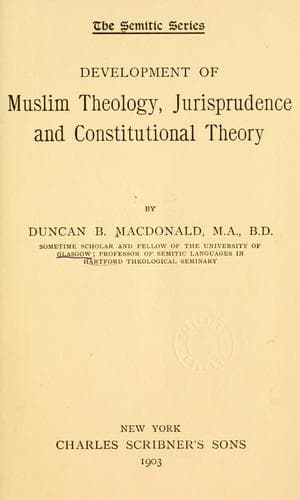
Development of Muslim Theology, Jurisprudence, and Constitutional TheoryMacDonald, Duncan Black
ReligionIslamic
Development of Muslim Theology, Jurisprudence, and Constitutional Theory
MacDonald, Duncan Black
Constitutional law (Islamic law); Islam -- Doctrines -- History; Islam and state -- History; Islamic law -- History
And, in truth, the very soul of Islam sprang from these solitary hermits,
scattered here and there throughout the desert, consecrating their lives
to God, and fleeing from the wrath to come. Even in pre-Islamic Arabic
poetry we feel how strong was the impression made on the Arab mind by the
gaunt, weird men with their endless watchings and night prayers. Again
and again there is allusion to the lamp of the hermit shining through
the darkness, and we have pictures of the caravan or of the solitary
traveller on the night journey cheered and guided by its glimmer. These
Christian hermits and the long deserted ruins telling of old, forgotten
tribes—judged and overthrown by God, as the Arabs held and hold—that lie
throughout the Syrian waste and along the caravan routes were the two
things that most stirred the imagination of Muhammad and went to form
his faith. To Muhammad, and to the Semite always, the whole of life was
but a long procession from the great deep to the great deep again. Where
are the kings and rulers of the earth? Where are the peoples that were
mighty in their day? The hand of God smote them and they are not. There
is naught real in the world but God. From Him we are, and unto Him we
return. There is nothing for man but to fear and worship. The world is
deceitful and makes sport of them that trust it.
Such is the oversong of all Muslim thought, the faith to which the Semite
ever returns in the end. To this the later Murji’ites opposed a doctrine
of Faith, which was Pauline in its sweep. Faith, they declared, saved,
and Faith alone. If the sinner believed in God and His Prophet he would
not remain in the fire. The Kharijites, on the other hand, held that
the sinner who died unrepentant would remain therein eternally, even
though he had confessed Islam with his lips. The unrepentant sinner, they
considered, could not be a believer in the true sense. This is still
the Ibadite position, and from it developed one of the most important
controversies of Islam as to the precise nature of faith. Some extreme
Murji’ites held that faith (_iman_) was a confession in the heart,
private intercourse with God, as opposed to Islam, public confession with
the lips. Thus, one could be a believer (_mu’min_), and outwardly confess
Judaism or Christianity; to be a professed Muslim was not necessary.
This is like the doctrine of the Imamites, called _taqiya_, that it is
allowable in time of stress to dissemble one’s religious views; and it is
worth noticing that Jahm ibn Safwan (killed, 131?), one of these extreme
Murji’ites, was a Persian proselyte in rebellion against the Arab rule,
and of the loosest religious conduct. But these Antinomians were no more
Muslims than the Anabaptists of Munster had a claim to be Christians. The
other wing of the Murji’ites is represented by Abu Hanifa, who held that
faith (_iman_) is acknowledgment with the tongue as well as the heart and
that works are a necessary supplement. This is little different from the
Public-domain text, read in full here on John Shaqi.
Reviews
Reviews
No reviews yet
Be the first to share your thoughts on this work.
Elsewhere in the archive
Join the Discussion
Join the discussion
Sign in to leave a comment or review.
Sign InorCreate an account