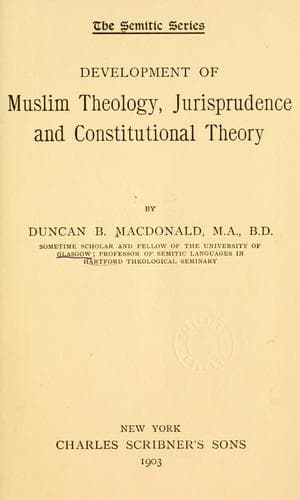
Development of Muslim Theology, Jurisprudence, and Constitutional TheoryMacDonald, Duncan Black
ReligionIslamic
Development of Muslim Theology, Jurisprudence, and Constitutional Theory
MacDonald, Duncan Black
Constitutional law (Islamic law); Islam -- Doctrines -- History; Islam and state -- History; Islamic law -- History
orthodox position which grew up, that persuasion, confession, and works
made up faith. When Murji’ism dropped out of existence as a sect it left
as its contribution to Islam a distinction between great and little sins
(_kabiras_, _saghiras_), and the position that even great sins, if not
involving polytheism (_shirk_), would not exclude the believer forever
from the Garden.
[Sidenote: QADARITES]
The second sect, that of Qadarites, had its origin in a philosophical
necessity of the human mind. A perception of the contradiction between
man’s consciousness of freedom and responsibility, on the one hand, and
the absolute rule and predestination of God, on the other, is the usual
beginning of the thinking life, both in individuals and in races. It was
so in Islam. In theology as in law, Muhammad had been an opportunist pure
and simple. On the one hand, his Allah is the absolute Semitic despot who
guides aright and leads astray, who seals up the hearts of men and opens
them again, who is mighty over all. On the other hand, men are exhorted
to repentance, and punishment is threatened against them if they remain
hardened in their unbelief. All these phases of a wandering and intensely
subjective mind, which lived only in the perception of the moment,
appear in the Qur’an. Muhammad was a poet rather than a theologian; just
as he was a prophet rather than a legislator. As soon, then, as the
Muslims paused in their career of conquest and began to think at all,
they thought of this. Naturally, so long as they were fighting in the
Path of God, it was the conception of God’s absolute sovereignty which
most appealed to them; by it their fates were fixed, and they charged
without fear the ranks of the unbelievers. In these earliest times,
the fatalistic passages bore most stress and the others were explained
away. This helped, at least, to bring it about that the party which in
time came to profess the freedom of man’s will, began and ended as an
heretical sect. But it only helped, and we must never lose sight of the
fact that the eventual victory in Islam of the absolute doctrine of God’s
eternal decree was the victory of the more fundamental of Muhammad’s
conflicting conceptions. The other had been much more a campaigning
expedient.
Public-domain text, read in full here on John Shaqi.
Reviews
Reviews
No reviews yet
Be the first to share your thoughts on this work.
Elsewhere in the archive
Join the Discussion
Join the discussion
Sign in to leave a comment or review.
Sign InorCreate an account