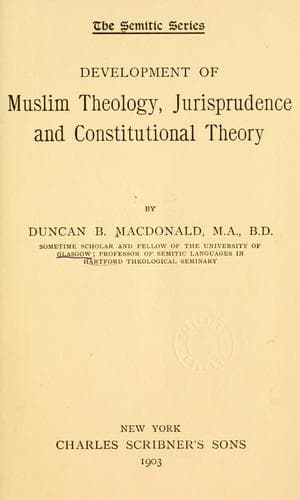
Development of Muslim Theology, Jurisprudence, and Constitutional TheoryMacDonald, Duncan Black
ReligionIslamic
Development of Muslim Theology, Jurisprudence, and Constitutional Theory
MacDonald, Duncan Black
Constitutional law (Islamic law); Islam -- Doctrines -- History; Islam and state -- History; Islamic law -- History
We return, now, to the beginnings of the Mu‘tazilites. These served
themselves heirs upon the Qadarites and denied that God predestined
the actions of men. Death and life, sickness, health, and external
vicissitudes came, they admitted, by God’s _qadar_, but it was
unthinkable that man should be punished for actions not in his control.
The freedom of the will is an _a priori_ certainty, and man possesses
_qadar_ over his own actions. This was the position of Wasil ibn Ata, of
whom we have already heard. But to it he added a second doctrine, the
origin of which is obscure, although suggestive of discussions with Greek
theologians. The Qur’an describes God as willing, knowing, decreeing,
etc.—strictly as the Willing One, the Knowing One, the Decreeing One,
etc.—and the orthodox hold that such expressions could only mean that
God possesses as Qualities (_sifat_) Will, Knowledge, Power, Life, etc.
To this Wasil raised objections. God was One, and such Qualities would
be separate Beings. Thus, his party and the Mu‘tazilites always called
themselves the People of Unity and Justice (_Ahl-at-tawhid wal‘adl_); the
Unity being of the divine nature, the Justice consisting in that they
opposed God’s _qadar_ over men and held that He must do for the creature
that which was best for it. Orthodox Islam held and holds that there can
be no necessity upon God, even to do justice; He is absolutely free,
and what He does man must accept. It flatly opposes the position held
by the Mu‘tazilites in general, that good and evil can be perceived and
distinguished by the intellect (_aql_). Good and evil have their nature
by God’s will, and man can learn to know them only by God’s teachings and
commands. Thus, except through revelation, there can be neither theology
nor ethics.
[Sidenote: ABU HUDHAYL]
Public-domain text, read in full here on John Shaqi.
Reviews
Reviews
No reviews yet
Be the first to share your thoughts on this work.
Elsewhere in the archive
Join the Discussion
Join the discussion
Sign in to leave a comment or review.
Sign InorCreate an account