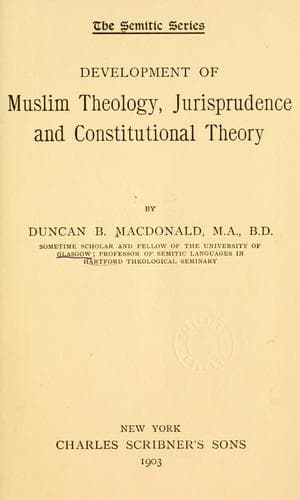
Development of Muslim Theology, Jurisprudence, and Constitutional TheoryMacDonald, Duncan Black
ReligionIslamic
Development of Muslim Theology, Jurisprudence, and Constitutional Theory
MacDonald, Duncan Black
Constitutional law (Islamic law); Islam -- Doctrines -- History; Islam and state -- History; Islamic law -- History
That they did willingly, and so, through three intermediaries, science
came to the Arabs. There was a heathen Syrian source with its centre at
Harran, of which we know comparatively little. There was a Christian
Syrian source working from the multitudinous monasteries scattered over
the country. There was a Persian source by which natural science, and
medicine especially, were passed on. Already in the fifth century A.D.
an academy of medicine and philosophy had been founded at Gondeshapur
in Khuzistan. One of the directors of this institution was summoned,
in 148, to prescribe for al-Mansur, and from that time on it furnished
court physicians to the Abbasids. On these three paths, then, Aristotle
and Plato, Euclid and Ptolemy, Galen and Hippocrates reached the Muslim
peoples.
[Sidenote: GOLDEN AGE OF MUSLIM SCIENCE]
The first hundred years of the Abbasid Khalifate was the golden age of
Muslim science, the period of growth and development for the People of
Muhammad fairly as a whole. Intellectual life did not cease with the
close of that period, but the Khalifate ceased to aid in carrying the
torch. Thereafter, learning was protected and fostered by individual
rulers here and there, and individual investigators and scholars still
went on their own quiet paths. But free intellectual life among the
people was checked, and such learning as still generally flourished
fell more and more between fixed bounds. Scholasticism, with its formal
methods and systems, its subtle deductions and endless ramifications of
proof and counter-proof, drew away attention from the facts of nature.
The oriental brain studied itself and its own workings to the point
of dizziness, and then turned and clung fast to the certainties of
revelation. Under this spell heresy and orthodoxy proved alike sterile.
Public-domain text, read in full here on John Shaqi.
Reviews
Reviews
No reviews yet
Be the first to share your thoughts on this work.
Elsewhere in the archive
Join the Discussion
Join the discussion
Sign in to leave a comment or review.
Sign InorCreate an account