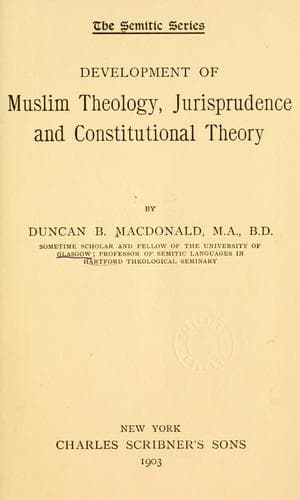
Development of Muslim Theology, Jurisprudence, and Constitutional TheoryMacDonald, Duncan Black
ReligionIslamic
Development of Muslim Theology, Jurisprudence, and Constitutional Theory
MacDonald, Duncan Black
Constitutional law (Islamic law); Islam -- Doctrines -- History; Islam and state -- History; Islamic law -- History
His position on the _qadar_ question was peculiar. With regard to this
world, he was a Qadarite; but in the next world, both in heaven and in
hell, he thought that all changes were by divine necessity. Otherwise,
that is, if men were free, there would be obligation to observe a law
(_taklif_); but there is no such obligation in the other world. Thus,
whatever happened there happened by God’s decree. Further, he taught
that, eventually, nothing would happen there; that there would be no
changes, but only an endless stillness in which those in heaven had all
its joys and those in hell all its pains. This is a close approximation
to the view of Jahm ibn Safwan, who held that after the judgment both
heaven and hell would pass away and God remain alone as He was in the
beginning. To these doctrines Abu Hudhayl seems to have been led by two
considerations, both significant for the drift of the Mu‘tazilites.
First, there was about their reasonings a grimness of logic touched with
utilitarianism. Thus, from their position that man could come by the
light of his reason to the knowledge of God and of virtue, they drew the
conclusion that it was man’s duty so to attain, and that God would damn
eternally every man who did not. Their utilitarianism, again, comes out
strikingly in their view of heaven and hell. These, at present, were
serving no useful purpose because they had no inhabitants; therefore, at
present, they did not exist. But this made difficulties for Abu Hudhayl.
What has a beginning must have an end. So he explained the end as the
ceasing of all changes. Second, he shows clear evidence of influence from
Greek philosophy. The Qur’an teaches that the world has been created in
time; Aristotle, that it is from eternity and to eternity. The creation,
Abu Hudhayl applied to changes; before that, the world _was_, but in
eternal rest. Hereafter, all changes will cease; rest will again enter
and endure to all eternity. We shall see how largely this doctrine was
advanced and developed by his successors.
But there were further complications in the doctrine of man’s actions and
into some of these we must enter, on account of their later importance.
Not everything that comes from the action of a man is by his action. God
has a creative part in it, apparently as regards the effects. Especially,
knowledge in the mind of a pupil does not come from the teacher, but from
God. The idea seems to be that the teacher may teach, but that the being
taught in the pupil is a divine working. Similarly, he distinguished
motions in the mind, which he held were not altogether due to the man,
and external motions which were. There is given, too, to a man at the
time of his performing an action an ability to perform the action, which
is a special accident in him apart from any mere soundness of health or
limb.
Public-domain text, read in full here on John Shaqi.
Reviews
Reviews
No reviews yet
Be the first to share your thoughts on this work.
Elsewhere in the archive
Join the Discussion
Join the discussion
Sign in to leave a comment or review.
Sign InorCreate an account