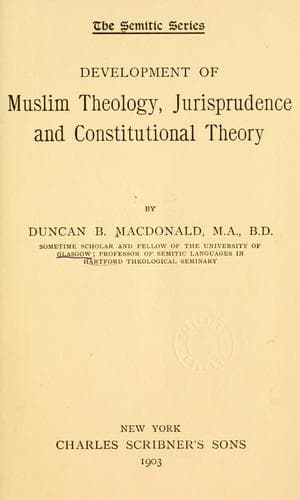
Development of Muslim Theology, Jurisprudence, and Constitutional TheoryMacDonald, Duncan Black
ReligionIslamic
Development of Muslim Theology, Jurisprudence, and Constitutional Theory
MacDonald, Duncan Black
Constitutional law (Islamic law); Islam -- Doctrines -- History; Islam and state -- History; Islamic law -- History
In these ways, Abu Hudhayl recognized God’s working through man. Another
of his positions had a similar basis and was a curious combination of
historical criticism and mysticism, a combination which we shall find
later in al-Ghazzali, a much greater man. The evidence of tradition for
things dealing with the Unseen World (_al-ghayb_) he rejected. Twenty
witnesses might hand on the tradition in question, but it was not to be
received unless among them there was one, at least, of the People of
Paradise. At all times, he taught, there were in the world these Friends
of God (_awliya Allah_, sing. _wali_), who were protected against all
greater sins and could not lie. It is the word of these that is the basis
for belief, and the tradition is merely a statement of what they have
said. This shows clearly how far the doctrine of the ecstatic life and of
knowledge gained through direct intercourse between the believer and God
had already advanced.
But Abu Hudhayl was only one in a group of daring and absolutely
free-minded speculators. They were applying to the ideas of the Qur’an
the keen solvent of Greek dialectic, and the results which they obtained
were of the most fantastically original character. Thrown into the wide
sea and utter freedom of Greek thought, their ideas had expanded to the
bursting point and, more than even a German metaphysician, they had lost
touch of the ground of ordinary life, with its reasonable probabilities,
and were swinging loose on a wild hunt after ultimate truth, wielding as
their weapons definitions and syllogisms. The lyric fervors of Muhammad
in the Qur’an gave scope enough of strange ideas from which to start, or
which had to be explained away. Their belief in the powers of the science
of logic was unfailing, and, armed with Aristotle’s “Analytics,” they
felt sure that certainty was within their reach. It was at the court and
under the protection of al-Ma’mun that they especially flourished, and
some account of the leading spirits among them will be necessary before
we describe how they reached their utmost pride of power and how they
fell.
[Sidenote: AN-NAZZAM]
Public-domain text, read in full here on John Shaqi.
Reviews
Reviews
No reviews yet
Be the first to share your thoughts on this work.
Elsewhere in the archive
Join the Discussion
Join the discussion
Sign in to leave a comment or review.
Sign InorCreate an account