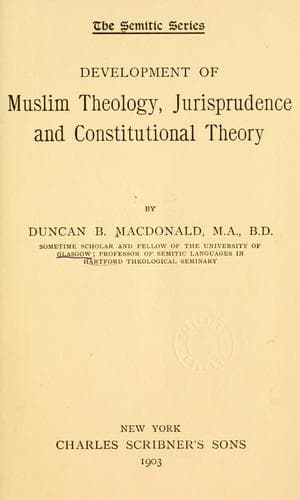
Development of Muslim Theology, Jurisprudence, and Constitutional TheoryMacDonald, Duncan Black
ReligionIslamic
Development of Muslim Theology, Jurisprudence, and Constitutional Theory
MacDonald, Duncan Black
Constitutional law (Islamic law); Islam -- Doctrines -- History; Islam and state -- History; Islamic law -- History
With one other detail of this class we must deal at greater length. It
was destined to be the vital point of the whole Mu‘tazilite controversy
and the test by which theologians were tried and had their places
assigned. It had a weighty part also in bringing about the fall of the
Mu‘tazilites. There had grown up very early in the Muslim community
an unbounded reverence and awe in the presence of the Qur’an. In it
God speaks, addressing His servant, the Prophet; the words, with
few exceptions, are direct words of God. It is, therefore, easily
intelligible that it came to be called the word of God (_kalam Allah_).
But Muslim piety went further and held that it was uncreated and had
existed from all eternity with God. Whatever proofs of this doctrine may
have been brought forward later from the Qur’an itself, we can have no
difficulty in recognizing that it is plainly derived from the Christian
Logos and that the Greek Church, perhaps through John of Damascus, has
again played a formative part. So, in correspondence with the heavenly
and uncreated Logos in the bosom of the Father, there stands this
uncreated and eternal Word of God; to the earthly manifestation in Jesus
corresponds the Qur’an, the Word of God which we read and recite. The
one is not the same as the other, but the idea to be gained from the
expressions of the one is equivalent to the idea which we would gain
from the other, if the veil of the flesh were removed from us and the
spiritual world revealed.
[Sidenote: THE WORD OF GOD]
That this view grew up very early among the Muslims is evident from
the fact that it is opposed by Jahm ibn Safwan, who was killed toward
the end of the Umayyad period. It seems to have originated by a kind
of transfusion of ideas from Christianity and not as a result of
controversy or dialectic about the teachings of the Qur’an. We find
the orthodox party vehemently opposing discussion on the subject, as
indeed they did on all theological subjects. “Our fathers have told
us; it is the faith received from the Companions;” was their argument
from the earliest time we can trace. Malik ibn Anas used to cut off all
discussions with “_Bila kayfa_” (Believe without asking how); and he held
strongly that the Qur’an was uncreated. The same word _kalam_ which we
have found applied to the Word of God—both the eternal, uncreated Logos
and its manifestation in the Qur’an—was used by them most confusingly for
“disputation;” “he disputed” was _takallam_ and “one who disputed” was
_mutakallim_. All that was anathema to the pious, and it is amusing to
see the origin of what became later the technical terms for scholastic
theology and its students in their shuddering repulsion to all “talking
about” the sacred mysteries.
Public-domain text, read in full here on John Shaqi.
Reviews
Reviews
No reviews yet
Be the first to share your thoughts on this work.
Elsewhere in the archive
Join the Discussion
Join the discussion
Sign in to leave a comment or review.
Sign InorCreate an account