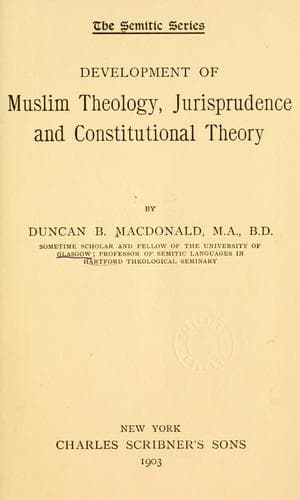
Development of Muslim Theology, Jurisprudence, and Constitutional TheoryMacDonald, Duncan Black
ReligionIslamic
Development of Muslim Theology, Jurisprudence, and Constitutional Theory
MacDonald, Duncan Black
Constitutional law (Islamic law); Islam -- Doctrines -- History; Islam and state -- History; Islamic law -- History
The last of this group whose views we need consider, is Thumama ibn
Ashras. He was of very dubious morals; was imprisoned as a heretic by
Harun ar-Rashid, but highly favored by al-Ma’mun, in whose Khalifate
he died, A.H. 213. He held that actions produced through _tawallud_
had no agent, either God or man. That knowledge of good and evil could
be produced by _tawallud_ through speculation, and is, therefore, an
action without an agent, and required even before revelation. That
Jews, Christians, Magians will be turned into dust in the next world
and will not enter either Paradise or Hell; the same will be the fate
of cattle and children. That any one of the unbelievers who does not
know his Creator is excusable. That all knowledge is _a priori_. That
the only action which men possess is will; everything besides that is a
production without a producer. That the world is the act of God by His
nature, _i.e._, it is an act which His nature compels Him to produce;
is, therefore, from eternity and to eternity with Him. It may be doubted
how far Thumama was a professional theologian and how far he was a
free-thinking, easy-living man of letters.
In all this, the influence of Greek theology and of Aristotle can be
clearly traced. With Aristotle had come to them the idea of the world
as law, an eternal construction subsisting and developing on fixed
principles. This conception of law shows itself in their thought frankly
at strife with Muhammad’s conception of God as will, as the sovereign
over all. Hence, the crudities and devices by which they strove to make
good their footing on strange ground and keep a right to the name of
Muslim, while changing the essence of their faith. The anthropomorphic
God of Muhammad, who has face and hands, is seen in Paradise by the
believer and settles Himself firmly upon His throne, becomes a spirit,
and a spirit, too, of the vaguest kind.
[Sidenote: THE VISION OF GOD]
It remains now only to touch upon one or two points common to all the
Mu‘tazilites. First, the Beatific Vision of God in Paradise. It was a
fixed agreement of the early Muslim Church, based on texts of the Qur’an
and on tradition, that some believers, at least, would see and gaze upon
God in the other world; this was the highest delight held out to them.
But the Mu‘tazilites perceived that vision involved a directing of the
eyes on the part of the seer and position on the part of the seen. God
must, therefore, be in a place and thus limited. So they were compelled
to reject the agreement and the traditions in question and to explain
away the passages in the Qur’an. Similarly, in Qur’an vii. 52, we read
that God settled Himself firmly upon His throne. This, with other
anthropomorphisms of hands and feet and eyes, the Mu‘tazilites had to
explain away in a more or less cumbrous fashion.
Public-domain text, read in full here on John Shaqi.
Reviews
Reviews
No reviews yet
Be the first to share your thoughts on this work.
Elsewhere in the archive
Join the Discussion
Join the discussion
Sign in to leave a comment or review.
Sign InorCreate an account