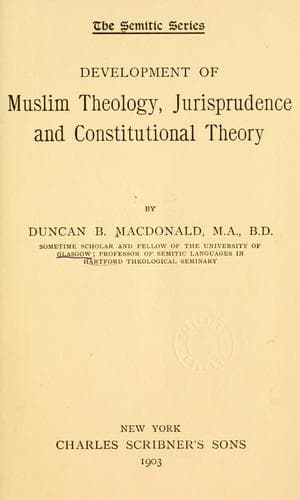
Development of Muslim Theology, Jurisprudence, and Constitutional TheoryMacDonald, Duncan Black
ReligionIslamic
Development of Muslim Theology, Jurisprudence, and Constitutional Theory
MacDonald, Duncan Black
Constitutional law (Islamic law); Islam -- Doctrines -- History; Islam and state -- History; Islamic law -- History
But if this doctrine grew up early in Islam, opposition to it was
not slow in appearing, and that on different sides. Literary vanity,
national pride, and philosophical scruples all made themselves felt.
Even in Muhammad’s lifetime, according to the legend of the poet Labid
and the verses which he put up in challenge on the Ka‘ba, the Qur’an had
taken rank as inimitable poetry. At all points it was the Word of God
and perfect in every detail. But, among the Arabs, a jealous and vain
people, if there was one thing on which each was more jealous and vain
than another, it was skill in working with words. The superiority of
Muhammad as a Prophet of God they might endure, though often with a bad
grace; but Muhammad as a rival and unapproachable literary artist they
could not away with. So we find satire of the weaknesses of the Qur’an
appearing here and there, and it came to be a sign of emancipation and
freedom from prejudice to examine it in detail and balance it against
other products of the Arab genius. The rival productions of Musaylima,
the False Prophet, long enjoyed a semi-contraband existence, and Abu
Ubayda (d. 208) found it necessary to write a treatise in defence of
the metaphors of the Qur’an. Among the Persians this was still more the
case. To them, Muhammad might be a prophet, but he was also an Arab; and
while they accepted his mission, accepting his books in a literary way
was too much for them. As a prophet, he was a man; as a literary artist,
he was an Arab. So Jahm ibn Safwan may have felt; so, certainly, others
felt later. The poet Bashshar ibn Burd (killed for satire, in 167), a
companion of Wasil ibn Ata and a Persian of very dubious orthodoxy, used
to amuse himself by comparing poems by himself and others with passages
in the Qur’an, to the disadvantage of the latter. And Ibn al-Muqaffa
(killed about 140), the translator of “Kalila and Dimna” and many other
books into Arabic, and a Persian nationalist, is said to have planned an
imitation of the Qur’an.
[Sidenote: MU‘TAZILITE ATTITUDE]
Added to all this came the influence of the Mu‘tazilite theologians. They
had a double ground for their opposition. The doctrine of an absolutely
divine and perfect book limited them too much in their intellectual
freedom. They were willing to respect and use the Qur’an, but not to
accept its _ipsissima verba_. Regarded as the production of Muhammad
under divine influence, it could have a human and a divine side, and
things which needed to be dropped or changed in it could be ascribed to
the human side. But that was not possible with a miraculous book come
down from heaven. In a word, they were meeting the difficulty which has
been met by Christianity in the latter half of the nineteenth century.
The least they could do was to deny that the Qur’an was uncreated.
Public-domain text, read in full here on John Shaqi.
Reviews
Reviews
No reviews yet
Be the first to share your thoughts on this work.
Elsewhere in the archive
Join the Discussion
Join the discussion
Sign in to leave a comment or review.
Sign InorCreate an account