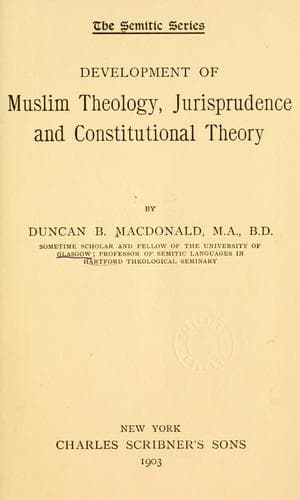
Development of Muslim Theology, Jurisprudence, and Constitutional TheoryMacDonald, Duncan Black
ReligionIslamic
Development of Muslim Theology, Jurisprudence, and Constitutional Theory
MacDonald, Duncan Black
Constitutional law (Islamic law); Islam -- Doctrines -- History; Islam and state -- History; Islamic law -- History
But they had a still more vital, if not more important, philosophical
base of objection. We have seen already how they viewed the doctrine of
God’s qualities (_sifat_) and tried to limit them in every way. These
qualities ran danger, they held, of being hypostatized into separate
persons like those in the Christian Trinity, and we have just seen how
near that danger really lay in the case of God’s _kalam_. In orthodox
Islam it has become a plain Logos.
The position in this of an-Nazzam has been given above. It is interesting
as showing that the Qur’an, even then, was given as a probative miracle
(_mu‘jiz_) because it deprived all men of power (_i‘jaz_) to imitate it.
That is, its æsthetic perfection was raised to the miraculous degree and
then regarded as a proof of its divine origin. But al-Muzdar, a pupil of
Bishr ibn al Mu‘tamir and an ascetic of high rank, called the Monk of
the Mu‘tazilites, went still further than an-Nazzam. He flatly damned as
unbelievers all who held the eternity of the Qur’an; they had taken unto
themselves two Gods. Further, he asserted that men were quite capable of
producing a work even finer than the Qur’an in point of style. But the
force of this opinion is somewhat diminished by the liberality with which
he denounced his opponents in general as unbelievers. Stories are told
of him very much like those in circulation with us about those who hold
that few will be saved, and it is worth noticing that upon this point of
salvability the Mu‘tazilites were even narrower than the orthodox.
CHAPTER II
Al-Ma’mun and the triumph of the Mu‘tazilites; the Mihna and
Ahmad ibn Hanbal; al-Farabi; the Fatimids and the Ikhwan
as-Safa; the early mystics, ascetic and pantheistic; al-Hallaj.
Public-domain text, read in full here on John Shaqi.
Reviews
Reviews
No reviews yet
Be the first to share your thoughts on this work.
Elsewhere in the archive
Join the Discussion
Join the discussion
Sign in to leave a comment or review.
Sign InorCreate an account