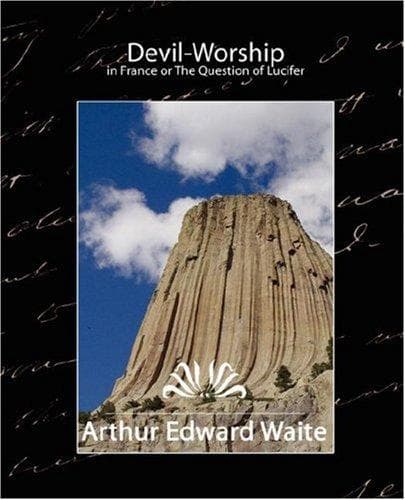
Devil-Worship in France; or, The Question of LuciferWaite, Arthur Edward
Religion
Devil-Worship in France; or, The Question of Lucifer
Waite, Arthur Edward
Satanism
Our inquiry into modern devil-worship does not warrant us in discussing
the position of writers who choose to assume that the Kabbalah,
Gnosticism, and other systems are _a priori_ diabolical, because
assumptions of this kind are unreasonable. There are writers at this
moment in France who argue that the English word God is the equivalent
of Lucifer, but one does not dispute with these. For the satisfaction of
my readers, it may, however, be as well to state that the voluminous
treatise of Mgr. Meurin has come into existence because he has
discovered, as one might say, accidentally, that the number 33, which is
that of the degrees in French Freemasonry, is the number of the
divinities in the Vedas, thus creating a presumption that the mysteries
of Freemasonry connect with those of antiquity. Of course they connect
with antiquity, for the simple reason that there is a solidarity between
all symbolisms, and, moreover, it is perfectly clear that Masonry has
either inherited from the past by a perpetuated tradition, or has
borrowed therefrom. Mgr. Meurin had therefore as little reason to be
astonished at the correctness of his presumption when he came to work it
out as he had to be delighted with the inference which prevails
throughout his inquiry, namely, that the mysteries of pagan antiquity
were delusions of the devil, and that modern mysteries which connect
with those are also diabolical delusions. Indeed he is so continually
making discoveries which are fresh to himself, and to no one acquainted
with the subject, that one would be pleasantly diverted by his
simplicity if it were not for the bad faith which underlies his
assumptions. For example, every one who knows anything of Goetic
literature is aware that the rituals of black magic incorporate
heterogeneous elements from Kabbalistic sources, but to Mgr. Meurin this
fact comes with the force of a surprise.
His Masonic erudition is about as great and as little as his proficiency
in Kabbalah; he quotes Carlyle as "an authority," applies the term
orthodox to French Freemasonry exclusively, whereas the developments of
the Fraternity in France have always had a heterodox complexion, while
his tripartite classification of the 33 degrees of that rite and of the
Ancient Accepted Scotch Rite is made in an arbitrary manner to suit a
preconceived theory, and entirely effaces the importance inherent in
the first three grades, which are themselves the sum of Masonry.
Moreover, the classification in question is presented as a most secret
instruction imparted in some fastness of Masonry outside the 33 degrees,
but no authority is named.
Public-domain text, read in full here on John Shaqi.
Reviews
Reviews
No reviews yet
Be the first to share your thoughts on this work.
Join the Discussion
Join the discussion
Sign in to leave a comment or review.
Sign InorCreate an account