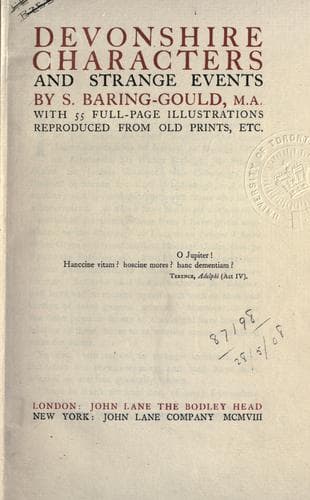
Devonshire Characters and Strange EventsBaring-Gould, S. (Sabine)
History
Devonshire Characters and Strange Events
Baring-Gould, S. (Sabine)
Devon (England) -- Biography; Devon (England) -- History
incensed when he discovered that he could not handle the revenues of
the estates, and this led to incessant bickerings. Clarendon says:--
“He had nothing to depend upon but the fortune of his wife: which,
though ample enough to have supported the expense a person of his
quality ought to have made, was not large enough to satisfy his vanity
and ambition. Nor so great as he, upon common reports, had promised
himself by her. By not being enough pleased with her fortune, he
grew less pleased with his wife; who, being a woman of a haughty
and imperious nature, and of a wit far superior to his own, quickly
resented the disrespect she received from him, and in no degree studied
to make herself easy to him. After some years spent together in these
domestic unsociable contestations, in which he possessed himself of
all her estate, as the sole master of it, without allowing her out of
her own any competency for herself, and indulging to himself all those
licences in her own house which to women are most grievous, she found
means to withdraw herself from him, and was with all kindness received
into the family in which she had before married, and was always very
much respected.”
Before proceeding with the quotation from Clarendon, it will be well
to give at once some illustrative touches as to the annoyances she
underwent at the hands of Sir Richard, and as to her own conduct
towards him. He confined her to a corner of her own house, Fitzford,
excluded her from the government of the house, and installed his aunt,
Mrs. Katherine Abbott, as his housekeeper, with control over the
servants and the keeping of the keys.
This was bad enough, but there was worse to come; his violence and
language towards her were so intolerable that she was constrained to
appeal to the justices of the peace, who ordered him to allow her forty
shillings a week. This, after a time, he refused to pay, unless she
would grant him an acquittance. All this is stated in the lady’s plea
to obtain a divorce in 1631-2. He also called her bad names before the
justices, “she being a vertuous and a chaste lady”--a pretty scene in
the court at Tavistock for the citizens to witness and listen to.
“He gave directions to one of his servantes to burn horse-haire, wooll,
feathers and parings of horse hoofes, and to cause the smoke to goe
into the ladye’s chamber, through an hole made in the plaistering
out of the kitchen. He broke up her chamber doore, and came into her
chamber at night with a sword drawn. That for the key of his closett
which she had taken away and denyed to give him, he tooke hold of her
petty coate and tore it, and threw her upon the ground, being with
childe, and, as one witness deposeth, made her eye blacke and blewe.”
Public-domain text, read in full here on John Shaqi.
Reviews
Reviews
No reviews yet
Be the first to share your thoughts on this work.
Elsewhere in the archive
Join the Discussion
Join the discussion
Sign in to leave a comment or review.
Sign InorCreate an account