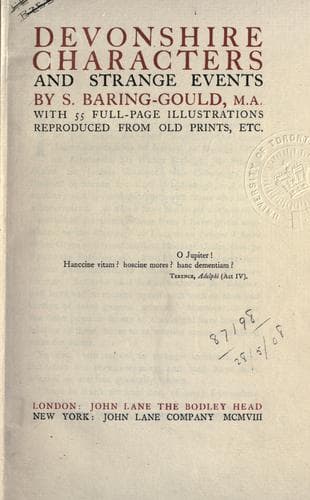
Devonshire Characters and Strange EventsBaring-Gould, S. (Sabine)
History
Devonshire Characters and Strange Events
Baring-Gould, S. (Sabine)
Devon (England) -- Biography; Devon (England) -- History
Sir Richard, on his side, complained, “That they had lived quietly
together for the space of two years, and till they came to this
Court.... That she hath often carried herself unseemly both in wordes
and deedes, and sunge unseemly songs to his face to provoke him, and
bid him goe to such a woman and such a woman, and called him a poore
rogue and pretty fellow, and said he was not worth ten groates when
she married him; that she would make him creepe to her, and that she
had good friends in London would beare her out of it. That she swore
the peace against him without cause, and then asked him, ‘Art thou not
a pretty fellow to be bound to the good behaviour?’ Then she said he
was an ugly fellow, and when he was once gone from home, she said, ‘The
Devill and sixpence goe with him, and soe shall he lacke neither money
nor company!’ That she said such a one was a honester man than her
husband, and loved Cuttofer (George Cutteford, her steward) better than
him. That there were holes made in the kitchen wall by the lady or her
daughter (i.e. Mary Howard), that he gave direction that they should be
stopped up, that she might not harken to what the servants said in the
kitchen, that she had ten roomes at pleasure, and had whatsoever in the
house she would desire. That she locked him into his closett and tooke
away the key, and it is true he endeavoured to take away the key from
her, and hurt his thumb and rent her pocket.”
Sir Richard certainly comes out best in the case. She was a woman of
insuperable pride, and with a violent temper and abusive, insulting
tongue. Having fled from Fitzford, and taken refuge with the family
of the Earl of Suffolk, Sir Richard for a while breathed free, and
rejoiced at her absence, till the tenants refused to pay rent into
his hands, whereupon he found himself without money; her pre-nuptial
settlement was put in force, and the trustees required the tenants to
pay their rents to them. To return to Clarendon. “This begat a suit in
Chancery between Sir Richard Grenville and the Earl of Suffolk, before
the Lord Coventry, who found the conveyance in Law to be so firm, that
he could not only not relieve Sir Richard Grenville in equity, but that
in justice he must decree the land to the Earl, which he did. This very
sensible mortification transported him so much, that being a man who
used to speak bitterly of those he did not love, after all endeavours
to engage the Earl in a personal conflict, he revenged himself upon
him in such opprobrious language as the Government and justice of
that time would not permit to pass unpunished; and the Earl appealed
for reparation to the Court of the Star Chamber, where Sir Richard was
decreed to pay three thousand pounds to the King, who gave the fine
likewise to the Earl; so that Sir Richard was committed to the prison
of the Fleet in execution for the whole six thousand pounds, which
at that time was thought by all men to be a very severe and rigorous
Public-domain text, read in full here on John Shaqi.
Reviews
Reviews
No reviews yet
Be the first to share your thoughts on this work.
Elsewhere in the archive
Join the Discussion
Join the discussion
Sign in to leave a comment or review.
Sign InorCreate an account