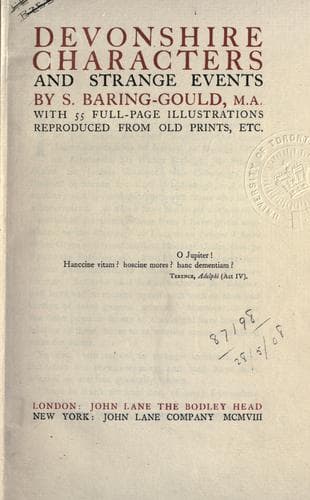
Devonshire Characters and Strange EventsBaring-Gould, S. (Sabine)
History
Devonshire Characters and Strange Events
Baring-Gould, S. (Sabine)
Devon (England) -- Biography; Devon (England) -- History
decree, and drew a general compassion towards the unhappy gentleman.
“For some years Sir Richard endured this imprisonment, which made him
the more bitter against his wife; he at length escaped his captivity,
and fled beyond seas. There he remained till the great change in
England having caused many decrees of the Star Chamber to be repealed,
and the persons awarded to pay penalties absolved, he came home and
petitioned to be heard in mitigation of his case. Before this came on,
the rebellion broke out in Ireland.” The proceedings for a divorce were
taken by Lady Grenville against her husband whilst he was a prisoner in
the Fleet, no doubt acting on the advice of the Earl of Suffolk, elder
brother of her late husband; and it was whilst she was in London at his
house that her second daughter, Elizabeth, was born. The court after
hearing arguments from counsel, decreed divorce _a mensa et thoro_, but
that one-half of her means should be paid to Sir Richard annually. In
August of the same year (1632), a commission was sent to Fitzford to
search the house, as Sir Richard was suspected of clipping the current
coin and of coining as well. Sir F. Drake and William Strode visited
the house, but notice of their coming had in some way been given.
They thoroughly searched “tronkes, chests and cabinetts,” and closely
examined Mrs. Abbott, Sir Richard’s aunt “who had the rule of the
house.” Pincers, holdfasts, files “smoothe and ruffe,” one of which had
been employed for yellow metal, were found, and the servants admitted
that they had melted silver lace, etc. All this, though suspicious, was
not conclusive, and the charge was not pressed. On 17 October, 1633,
Sir Richard escaped from the Fleet and entered the Swedish service in
Germany. Nothing is heard of him again till 1639. During these seven
years his emancipated wife lived in various places, for the first four
or five years with the Earl of Suffolk, and afterwards at her own house
in London. She had thrown off her name of Grenville and resumed that of
Howard.
Theophilus, Earl of Suffolk, was born in 1584, and was married to Lady
Elizabeth Hume, who died in 1533, the year after the divorce. To this
period probably belongs an episode that is shrouded in mystery. Lady
Howard had a son, George Howard, when born is not recorded.
Public-domain text, read in full here on John Shaqi.
Reviews
Reviews
No reviews yet
Be the first to share your thoughts on this work.
Elsewhere in the archive
Join the Discussion
Join the discussion
Sign in to leave a comment or review.
Sign InorCreate an account