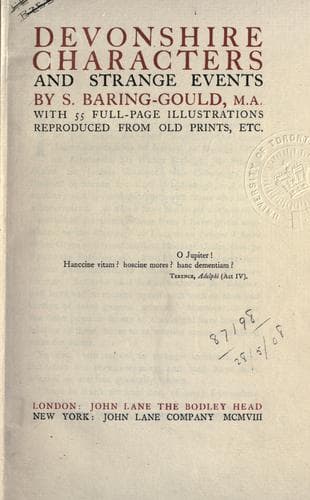
Devonshire Characters and Strange EventsBaring-Gould, S. (Sabine)
History
Devonshire Characters and Strange Events
Baring-Gould, S. (Sabine)
Devon (England) -- Biography; Devon (England) -- History
A committee was appointed to hear Sir Richard’s cause, in December,
1640, and so hopeful was he of success, that he actually went down
to Fitzford, turned out the caretakers, and installed his aunt there
again. Lady Howard wrote to her steward in “a very great distraction”
on hearing of these proceedings. But before his case was decided, he
was sent by the King to Ireland in command of a troop, and arrived
in Dublin in March, 1641-2. He remained in Ireland for more than
a year, and earned distinction as a commander. On his return, he
learned that the King, who was at Oxford, was short of money, and that
the Parliament in London had plenty. He had not been paid for his
services in Ireland, so he rode to where the money bags were, assumed
the Puritan cant and nasal twang, recounted his great service, and
protested his desire to quit the “Tents of Shem and cast in his lot
with the righteous,” i.e. to desert the royal cause. The Parliament was
delighted, he was at once paid all arrears, was made a major-general
of horse in the Parliamentary army, with a regiment of five hundred
horse, and power to choose his own officers. On 2 March, 1643-4, he
set out with his regiment, riding through London amidst the plaudits
of the citizens. His banner was carried in front, displaying a map
of England and Wales on a crimson ground, with “England bleeding” in
golden letters across the top. The regiment rode on as far as Bagshot,
when a halt was called. Then Sir Richard harangued the officers and
men, set forth the sinfulness of fighting against their anointed King,
and concluded by inviting them to follow him to Oxford, to fight for
the King instead of against him. The officers, whom he had not failed
to pick out from among his most trusty friends and dependents, all
cheerfully assented, and followed by most of his soldiers, Sir Richard
rode straight to Oxford and presented himself to the King at the
head of a well-equipped troop, and placed his sword at His Majesty’s
disposal. The Parliament, duped, was furious, a price was set on Sir
Richard’s head, and he was hanged in effigy. A Proclamation was issued,
declaring him “traytor, rogue, villain and skellum”--this last word
was deemed so appropriate that henceforth he was known as Skellum
Grenville. William Lilly, the astrologer, refers to him when he says:
“Have we another Red Fox like Sir R. G. acting his close devotions to
do our Army mischief? Let’s be wary!”
Public-domain text, read in full here on John Shaqi.
Reviews
Reviews
No reviews yet
Be the first to share your thoughts on this work.
Elsewhere in the archive
Join the Discussion
Join the discussion
Sign in to leave a comment or review.
Sign InorCreate an account