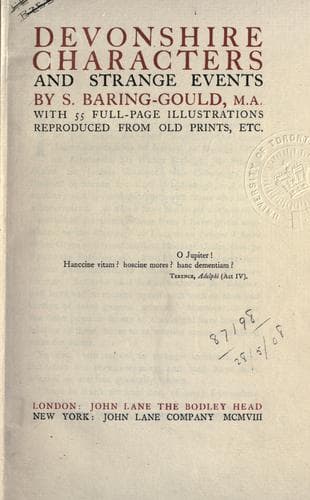
Devonshire Characters and Strange EventsBaring-Gould, S. (Sabine)
History
Devonshire Characters and Strange Events
Baring-Gould, S. (Sabine)
Devon (England) -- Biography; Devon (England) -- History
Sir Richard being now in high favour with the King made petition
to be given his wife’s estates in Devonshire, on the ground that
her continued residence in London made her a rebel. The King, with
monstrous injustice, granted what was asked, and at once--a fortnight
after his having marched out of London--he arrived in Tavistock, with
powers from the King to take possession of all his wife’s estates.
Armed with a warrant from Prince Maurice, then quartered at Tavistock,
Sir Richard threw Cutteford and his wife and son into prison, and
proceeded to plunder his house, and scrape together what money he could
from the tenants. Plymouth was at this time invested by the Royal
army; Sir Richard was placed in command, and he remained there till
the approach of Essex with a large army compelled him to retreat into
Cornwall with his troops, leaving only a few soldiers in his wife’s
house, Fitzford, to defend it.
Essex was not slow to avail himself of the chance of punishing Skellum
Grenville--the Red Fox--and his own regiment and another proceeded to
Fitzford, and after damaging it with cannon, compelled the garrison of
one hundred and eighty to lay down their arms. Those who agreed to take
the Covenant, about sixty, were enrolled in the Parliamentary army, the
rest were detained as prisoners. The house was given up to plunder.
There was in it “excellent pillage for the soldiers, even at least
£3000 in money and plate, and other provisions in great quantity.”
Unhappily, the plate, the money, the furniture, the provisions did not
belong to Skellum Grenville at all, but to Lady Howard, accounted a
Parliamentarian. They were his by usurpation only. After the defeat of
Essex in Cornwall, the King gave Sir Richard all the Earl of Bedford’s
estates and those of Sir Francis Drake, and he resumed command at the
siege of Plymouth. He was made Sheriff of Devon in the same year, 1645,
and his exactions were great, both as sheriff and as the “King’s
General in the West.” But he was not a man to behave with moderation;
he speedily abused all these favours, and his acts were so notoriously
tyrannical and cruel that they were formally brought as charges against
him before the Council, where he was summoned to appear in person
and answer for his misdeeds whilst governor of Lydford Castle. One
instance of his cruelty deserves particular notice, as it shows the
bitterness wherewith he recollected his quarrels with his wife. During
the time of her proceedings against him in Chancery she employed an
attorney-at-law whose name was Brabant; he bore the character of being
an honest man, and loyal to the King. He lived somewhere in this part
of Devonshire. Many years elapsed since the decision of that suit
against him, before Sir Richard became a man of so much importance by
his high military command in the west. No sooner did Brabant learn the
news of his arrival, than, well knowing he was not of a disposition to
Public-domain text, read in full here on John Shaqi.
Reviews
Reviews
No reviews yet
Be the first to share your thoughts on this work.
Elsewhere in the archive
Join the Discussion
Join the discussion
Sign in to leave a comment or review.
Sign InorCreate an account