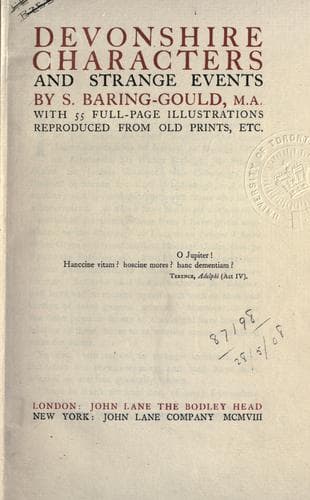
Devonshire Characters and Strange EventsBaring-Gould, S. (Sabine)
History
Devonshire Characters and Strange Events
Baring-Gould, S. (Sabine)
Devon (England) -- Biography; Devon (England) -- History
forget or forgive an old adversary, Brabant judged it prudent to keep
as much as possible out of the way. Having occasion, however, to make a
journey that would take him near Sir Richard’s quarters, he disguised
himself as well as he could and put on a montero cap. Sir Richard,
who probably had been on the watch to catch him, notwithstanding all
these precautions, received intelligence of the movements of the man of
law. He caused him to be intercepted on his road, made prisoner, and
brought before him. In vain did Brabant protest that he was journeying
on no errand but his own private affairs; for Sir Richard affecting,
on account of his montero cap, to believe him to be a spy, without a
council of war, or any further inquiry, ordered the luckless lawyer to
be hanged on the spot. The offences of Sir Richard were so gross that
he was sent a prisoner to St. Michael’s Mount, in Cornwall; but on the
approach of the Parliamentary army he was allowed to escape on 3 March,
1645-6. He sailed to Brest, and joined his son at Nantes.
Lady Howard, so soon as she heard that Sir Richard was out of England,
hastened down to Fitzford, where she found that her steward was dead
and her mansion wrecked. When the country was somewhat more peaceful
she brought down to it from London her furniture, books, and plate, and
set to work to repair the damage that the house had sustained. Her son,
George Howard, was with her and managed her affairs eventually, not at
first, for if he were born in 1634 he would be still a child.
Sir Richard Grenville and his son Richard wandered about the Continent
till 1647, when he formed the rash intention to return to London.
What induced him to take this desperate step can only be conjectured.
Perhaps he had money in London, which it was only possible to secure
personally; possibly he may have desired to get possession of his
daughter Elizabeth and take her abroad with him, rightly conjecturing
that her mother had no affection, but the contrary, for a child of his.
Indeed, it is probable that the tradition of Lady Howard’s persistent
hatred displayed towards one of her daughters pertains to this
Elizabeth Grenville.
There must have been some very strong reason for Sir Richard’s
venturing to England, for he knew perfectly in what estimation he was
held by the Puritans. He disguised himself, cutting his hair short
and wearing “a very large periwigg hanging on his shoulders,” and
blackening his foxy-red beard with a lead comb, so that “none would
know him but by his voyse.”
How he fared in England we know not; he did secure his daughter and
escaped with his life to Holland, but of his son we hear nothing more,
and it is possible that he met his death while in England.
Lord Lansdowne, in his _Vindication_ of his uncle, says, “His only son,
unluckily falling afterwards into whose hands, was hanged.”
Public-domain text, read in full here on John Shaqi.
Reviews
Reviews
No reviews yet
Be the first to share your thoughts on this work.
Elsewhere in the archive
Join the Discussion
Join the discussion
Sign in to leave a comment or review.
Sign InorCreate an account